

What is a digital content loop, and why does it matter for your business?
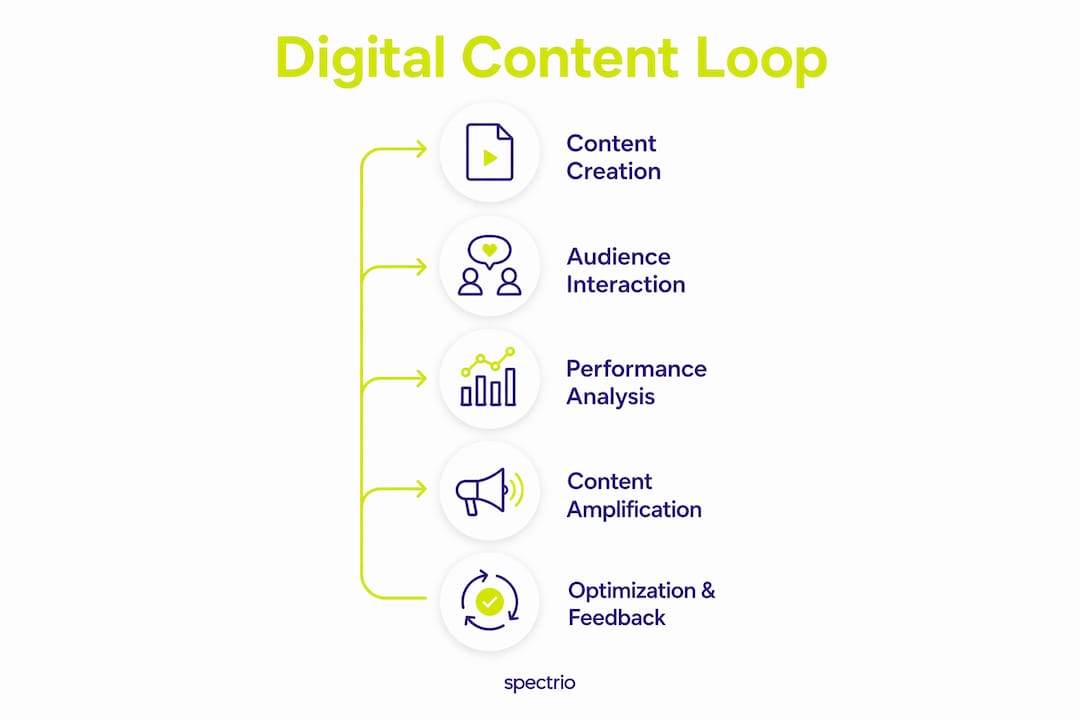
A digital content loop is a self-sustaining cycle where content creation, audience interaction, and amplification feed into each other continuously, rather than following a one-time linear path. Every customer interaction generates data that fuels the next round of content, compounding engagement over time. For businesses running digital signage and interactive kiosks, this model is especially powerful: your screens become a living system, not a static display.
The core elements of a content loop include:
- Content creation: Producing messages, visuals, or promotions tailored to your audience at a specific moment
- User interaction: Customers engage with your kiosk, dwell near your screen, or respond to a call to action
- Content amplification: Successful content gets redistributed, extended, or promoted across additional touchpoints
- Feedback integration: Behavioral data from interactions informs the next round of content, closing the cycle
Unlike a traditional marketing funnel, which pushes customers from awareness to purchase once, a content loop keeps cycling. Each rotation strengthens the next.
Table of Contents
- How digital content loops work in marketing and physical signage
- Business goals that digital content loops support in physical venues
- Best practices for implementing content loops with digital signage and kiosks
- Examples of digital content loops in action at physical locations
- What technical components power a digital content loop?
- Challenges and common pitfalls when deploying content loops
- How to personalize digital content loops for specific audiences
- Key Takeaways
- FAQ
How digital content loops work in marketing and physical signage
The cycle in marketing follows a clear path: creation triggers interaction, interaction fuels amplification, and amplification generates feedback that drives better creation. Most organizations complete the first two steps and stop. The feedback loop, where real learning occurs, never closes.

In physical digital signage environments, this dynamic becomes concrete and measurable. Real-time behavioral data, such as how long a customer stands near a display or which kiosk menu item they tap, directly informs what content appears next. The loop runs on data triggers, not guesswork.
Key steps in a physical signage content loop:
- Trigger detection: Time of day, foot traffic patterns, or inventory status activates a content change
- Dynamic content delivery: The screen updates to show the most relevant message for that moment
- Behavioral measurement: Dwell time, interaction rate, and conversion data are captured
- Content refinement: Insights feed back into the content schedule, improving future cycles
This is what separates a content loop strategy from a simple playlist. The content learns from its audience.
Business goals that digital content loops support in physical venues
Content loops are not just content calendars. RiseOpp frames them as a business operating system designed to achieve specific outcomes, whether that is increasing retail foot traffic, extending kiosk dwell time, or improving customer retention. The distinction matters: when your loop is built around a business goal, every content decision has a measurable purpose.
Greenlane Marketing reinforces this point directly:
For physical venues, the benefits compound quickly. Personalized content shown at the right moment reduces the need to constantly acquire new customers at the top of the funnel. Spectrio’s clients across retail, hospitality, and healthcare have seen improved engagement metrics and stronger retention by treating their digital signage as a feedback-driven system rather than a broadcast channel. Audience measurement capabilities built into Spectrio’s Intelligent Engagement Suite™ make it possible to track what resonates and act on it fast.
Best practices for implementing content loops with digital signage and kiosks
Execution separates a functioning loop from a broken one. These practices keep your content cycle healthy:
- Build modular content components: Treat logos, calls to action, and video clips as swappable elements so you can update messaging without costly full re-edits
- Assign content cadence tiers: Tier A assets (your highest-traffic screens) reviewed regularly, with Tier B assets checked on a less frequent schedule
- Set KPIs before you launch: Track engagement time, interaction rate, and conversion, not just impressions
- Run a 90-day optimization cycle: Analyze performance, adjust underperformers, and execute changes on a rolling quarterly schedule
- Retire stale content actively: Outdated messaging does not just sit idle; it erodes the relevance of everything around it
Pro Tip: Use real-time data triggers, such as time of day or current inventory levels, to automate content swaps. Pair this with audience segmentation so a lunch-hour crowd sees different messaging than an evening shopper.
The “autopilot trap” is the most common failure mode: content goes live, nobody reviews it, and six months later your screens are showing a promotion that ended in March. A scheduled review process prevents this entirely.
Examples of digital content loops in action at physical locations
Content loops show up in physical venues in more ways than most operators realize. Here are concrete scenarios where the cycle runs in practice:
- Time-sensitive promotions: A coffee shop’s kiosk shifts from breakfast combos to lunch specials at 10:30 AM automatically, triggered by time-of-day rules
- Inventory-driven messaging: A retail display stops promoting a sold-out item and replaces it with an in-stock alternative the moment inventory data updates
- Interactive kiosk feedback: A hotel lobby kiosk tracks which amenity options guests tap most, and the next content update features those services more prominently
- Dwell-time adaptation: A screen near a waiting area detects extended dwell time and shifts to longer-form content, such as a product demo, rather than a quick promotional flash
- Adaptive playlists: A digital signage playlist rotates content components dynamically based on audience measurement data gathered throughout the day
Each of these scenarios closes the loop: the environment responds to real behavior, content improves, and customer experience gets sharper with every cycle.
What technical components power a digital content loop?
A functioning content loop in a physical environment depends on several connected layers working together. The content management system (CMS) sits at the center, scheduling and distributing assets across screens and kiosks. Audience measurement tools, whether camera-based analytics or sensor data, feed behavioral signals back into the system. Integration with point-of-sale or inventory platforms allows real-time data triggers to fire content changes automatically.
On the software side, platforms need to support conditional playback rules, meaning content changes based on defined conditions rather than a fixed schedule. Spectrio’s platform combines content creation and management with audience measurement in a single suite, removing the integration burden that often breaks the feedback layer. Without a closed data pipeline from screen to analytics to content update, the loop cannot complete its cycle.
Challenges and common pitfalls when deploying content loops
The biggest pitfall is treating deployment as the finish line. Publishing content and walking away is the single most common reason loops fail. Without a measurement and iteration process, every piece of content has a built-in expiration date.
Other frequent challenges include:
- Siloed teams: Analytics, creative, and operations teams reporting on different KPIs with no shared feedback channel
- No content retirement process: Old assets accumulate, diluting the relevance of active messaging
- Over-reliance on automation: Automation handles scheduling, but humans must interpret performance data and make strategic calls
- Misaligned incentives: Teams rewarded for volume of content published rather than business outcomes achieved
Fixing these issues requires process, not just better software. Assign clear ownership for the measurement and optimization cycle, and make content performance a standing agenda item, not an afterthought.
How to personalize digital content loops for specific audiences
Personalization in a physical loop starts with segmentation. Not every customer in your location has the same need at the same moment, and your content should reflect that. Audience measurement tools can identify demographic signals, traffic patterns, and behavioral cues that allow your screens to serve different messages to different groups throughout the day.
Modular content architecture makes this practical. When your assets are built as independent components, a single screen can serve a loyalty-program message to a returning customer and a first-visit offer to someone new, without rebuilding the entire content set. Customer feedback gathered through kiosk interactions and dwell-time data provides the ongoing signal that keeps personalization accurate over time. Spectrio’s audience measurement capabilities support this kind of targeted delivery across retail, restaurant, and healthcare environments.
Key Takeaways
A digital content loop drives compounding customer engagement by cycling through creation, interaction, amplification, and feedback rather than relying on one-time funnel conversions.
| Point | Details |
|---|---|
| Loops outperform linear funnels | Every interaction generates data that fuels the next content cycle, reducing top-of-funnel dependency. |
| Physical signage needs data triggers | Time of day, dwell time, and inventory status should drive automatic content updates. |
| 90-day optimization cycles | Review and adjust all content assets on a rolling 60–90 day schedule to prevent stale messaging. |
| Modular content saves time | Swappable components like logos and CTAs allow personalization without full video re-edits. |
| Measurement closes the loop | Tracking engagement time, interaction rate, and conversion turns a playlist into a learning system. |
FAQ
What is a digital content loop in simple terms?
A digital content loop is a repeating cycle where content creation, audience interaction, and performance feedback each inform the next round of content, producing compounding engagement over time rather than a one-time result.
How does a content loop differ from a traditional marketing funnel?
A traditional funnel moves customers linearly from awareness to purchase and ends there. A content loop is cyclical: every interaction feeds back into the system to improve future content and re-engage the same audience.
What KPIs should you track for a digital signage content loop?
Track engagement time, interaction rate on kiosks, dwell time near displays, and conversion actions. Review these metrics on a 60–90 day cycle to identify what to refresh, retire, or amplify.
How often should digital signage content be updated?
Tier A assets, your highest-traffic screens, should be reviewed on a regular schedule. Lower-priority assets can follow a less frequent review cycle, with periodic audits to retire anything misaligned with current business goals.
Can small businesses use digital content loops effectively?
Yes. Modular content components and a clear 90-day review cadence make content loops practical at any scale. Platforms like Spectrio’s Intelligent Engagement Suite™ provide the audience measurement and content management tools needed to run a functioning loop without a large internal team. Explore how digital signage drives ROI to see what that looks like in practice.
Ready to put a content loop to work in your physical location? Spectrio’s Intelligent Engagement Suite™ connects digital signage, interactive kiosks, and audience measurement into one system built for continuous improvement. Whether you run a restaurant or a retail floor, Spectrio gives you the tools to close the loop and keep customers engaged.