


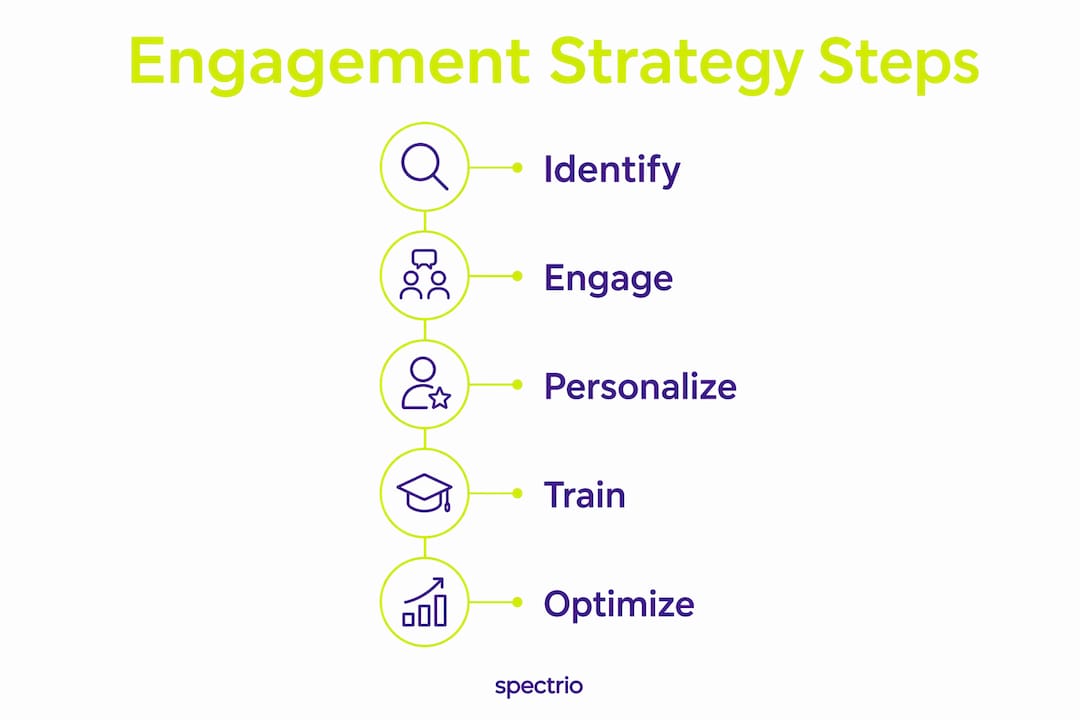
An effective in-store customer engagement strategy is a data-driven system that converts anonymous store visits into personalized, measurable relationships. It does not start with a loyalty app or a new display. It starts with a framework that treats every square foot of your store as an active participant in the customer relationship. The four stages that define this system are:
- Identify: Capture who is entering your store through digital receipts, loyalty sign-ups, or NFC interactions at the entrance.
- Engage: Deliver relevant messaging during aisle browsing through digital signage and interactive displays that match the shopper’s mindset at each zone.
- Personalize: Use checkout as your highest-value data capture moment, connecting purchase history to a unified customer profile.
- Retain: Follow up post-visit with targeted offers and content that bring shoppers back.
Each stage compounds the next. A shopper you identify at the entrance receives more relevant aisle messaging. A shopper you personalize at checkout is far more likely to respond to a post-visit offer. Physical retail’s unique advantage over e-commerce is the ability to layer sight, sound, scent, and human interaction into a single visit, creating impressions that reduce price sensitivity and shorten purchase decisions. The retailers winning in 2026 are the ones treating this not as a series of disconnected tactics, but as a connected customer journey.
Proven strategies to boost in-store customer engagement in 2026
1. Build unified customer profiles from day one
Personalization only works when you know who you are talking to. Start by connecting your point-of-sale (POS) system, loyalty program, and digital receipt platform so every transaction adds a data point to a customer profile. Associates who can see a shopper’s purchase history before a conversation have a concrete advantage. The goal is not to collect data for its own sake but to make every subsequent interaction feel less like a cold pitch and more like a continuation of a relationship.

2. Use digital signage with a single hero message per sign
Cluttered signage loses shoppers in seconds. Effective in-store messaging follows a clear hierarchy: one hero message per sign, a headline of seven words or fewer, and body copy under 20 words. Seasonal rotations keep the content fresh without requiring a full creative overhaul each month. Retail digital displays that follow this discipline consistently outperform busy, multi-message boards because they respect the shopper’s limited attention window.
3. Create multi-sensory brand experiences
Sight alone is not enough. Retailers who layer curated overhead music, signature scent, and tactile product displays create environments that shoppers remember and return to. Scent marketing, in particular, operates below conscious awareness, influencing dwell time and purchase mood without a single word of copy. Spectrio’s Intelligent Engagement Suite™ integrates sight, sound, and scent into a single managed system, removing the operational complexity of coordinating three separate vendors.
4. Train associates with micro-videos and quick-reference scripts
Staff are your most variable engagement asset. A well-designed digital sign means nothing if the associate standing next to it contradicts the message or ignores it entirely. Short micro-training videos tied directly to current campaigns give associates a fast, repeatable way to reinforce what shoppers see on screen. Pair these with a one-page quick-reference card at the start of each campaign cycle, and execution consistency improves across every shift.
5. Implement real-time triggers and contextual offers
Static promotions treat every shopper the same regardless of time, inventory, or behavior. AI-enabled in-store media adjusts messages in real time based on inventory levels, foot traffic patterns, and time of day, so a slow Tuesday afternoon can automatically surface a different offer than a busy Saturday. Connecting these triggers to your loyalty program means a returning customer who walks in at 2:00 PM on a weekday can receive a contextually relevant prompt, not a generic banner.
6. Connect physical and digital via QR codes and NFC
In-store messaging that leads with value beyond price and connects to digital via QR or app integrations drives measurable conversion. A QR code on a shelf talker that links to a how-to video, a product comparison, or a loyalty enrollment page extends the engagement beyond the physical display. NFC-enabled kiosks at high-traffic points can capture opt-ins in under 10 seconds, turning passive browsers into identifiable customers.
7. Build a clienteling program for high-value shoppers
Clienteling programs succeed when associates secure customer consent in the moment, use unified profiles, and follow consistent workflows that enable natural post-visit conversations. The result is higher average order values and clearer sales attribution. This is not a luxury retail tactic. Any store with repeat customers and a CRM can run a lightweight version: a text or email follow-up referencing the last purchase, sent within 48 hours, is enough to start.
8. Use local partnerships and user-generated content
Authenticity is one of the few things a physical store can deliver that a brand’s own marketing cannot. Partnering with a local business for a co-branded in-store event, or displaying real customer photos and reviews on a digital screen near the product they reference, adds social proof that paid advertising rarely achieves. User-generated content on in-store displays also gives shoppers a reason to photograph and share their experience, extending your reach without additional ad spend.
9. Align messaging to shopper mindset by store zone
The entrance, perimeter, and aisle each serve a different psychological moment. Shoppers at the entrance are orienting. Shoppers on the perimeter are discovering. Shoppers in the aisles are deciding. Messaging that matches this progression, orientation cues near the door, discovery prompts along the perimeter, and compelling reasons to buy in the aisles, performs better than a single campaign message plastered uniformly across all zones.
10. Incorporate omnichannel support at the point of need
A shopper who cannot find an answer in-store will pull out their phone. That is not a failure if you have designed for it. QR codes linking to live chat, in-store kiosks with product lookup, and associates equipped with tablets for real-time inventory checks all reduce friction at the moment of decision. Omnichannel integration ensures the customer experience does not break when a shopper moves between your physical and digital channels.
How to design and launch your engagement strategy step by step
Getting the sequence right matters as much as the tactics themselves. Here is a practical order of operations that minimizes wasted effort and generates early returns.
Start at checkout. Checkout is where the highest concentration of shoppers passes through, and it is the easiest place to capture data with minimal friction. Digital receipts, loyalty enrollment prompts, and QR-linked post-purchase surveys all work at this stage without requiring a full store overhaul. Build your data foundation here before layering in entrance and aisle touchpoints.
Build a shared Q-calendar. A quarterly campaign calendar aligned across your headquarters, field teams, and vendors prevents the last-minute scramble that kills execution quality. Map out seasonal themes, monthly rotations, and weekly updates with clear lead times for creative production, printing, and installation. Every stakeholder knows what is coming and when, so the store team is never surprised by a campaign they have not been briefed on.
- Assign a campaign owner for each rotation period.
- Set creative deadlines at least three weeks before installation.
- Include a sign-off checkpoint for compliance and brand consistency.
- Build in a localization window so individual stores can add relevant local details without breaking the master template.
Use planograms and signage checklists. A planogram is a visual map of where every display, sign, and product placement belongs. Pairing it with a pre-opening signage checklist gives store managers a fast daily audit tool. Misaligned price tags, expired promotions, and missing displays are the most common execution failures, and a checklist catches them before shoppers do.
Run A/B tests with control stores. Before rolling a new message format or campaign across your entire fleet, test it in two or three stores against a matched control group. Measure basket size, conversion rate, and dwell time over a two-week window. The results tell you whether the change is worth the cost of a full rollout, and they give you a defensible number to bring to your P&L review.
Pro Tip: Start your engagement program at checkout, not the entrance. Checkout captures nearly every shopper who visits, gives you the highest data capture rate with the least infrastructure investment, and generates the fastest measurable return. Once you have a data foundation from checkout, every upstream touchpoint becomes more effective.
How technology powers modern in-store customer engagement
Technology is not the strategy. It is the infrastructure that makes the strategy repeatable and measurable at scale.
- Digital screens and interactive kiosks serve as both engagement surfaces and data capture points. A screen that displays a promotion and a QR code for loyalty enrollment is doing two jobs simultaneously.
- AI-driven messaging systems adjust content in real time based on inventory, traffic, and time of day, replacing fixed schedules with adaptive programs that stay relevant without manual updates.
- Digital receipts and NFC/QR opt-ins turn checkout into a high-yield data capture moment. Digital receipts are the most effective customer data capture lever at checkout, significantly outperforming traditional email collection by associates asking verbally.
- Unified customer profiles aggregate data from POS, loyalty, digital receipts, and kiosk interactions into a single view, enabling personalization that improves with every visit.
- POS data combined with test-and-control methods isolates the true lift from any engagement initiative, so you can measure signage ROI with the same rigor you apply to paid media.
- Omnichannel extensions via app integrations, SMS follow-ups, and email sequences carry the in-store relationship forward after the shopper leaves, compounding the value of every visit.
The 2026 shift in retail media is from fixed content schedules to AI-powered, adaptive programs that respond to live store data. Retailers still running static weekly rotations are leaving measurable engagement on the table.
Analytics-driven marketing consistently delivers better ROI than campaign-based guesswork. Pairing your in-store data with a marketing analytics framework gives you the feedback loop needed to improve every campaign cycle, not just the ones that happen to perform well by chance.
How retail IoT and digital signage work together in your store
Retail IoT refers to the network of connected devices in a physical store: sensors, screens, kiosks, smart shelves, and beacons that collect and act on real-time data. When these devices are integrated with your digital signage platform, the result is a store environment that responds to what is actually happening rather than what was scheduled three weeks ago.
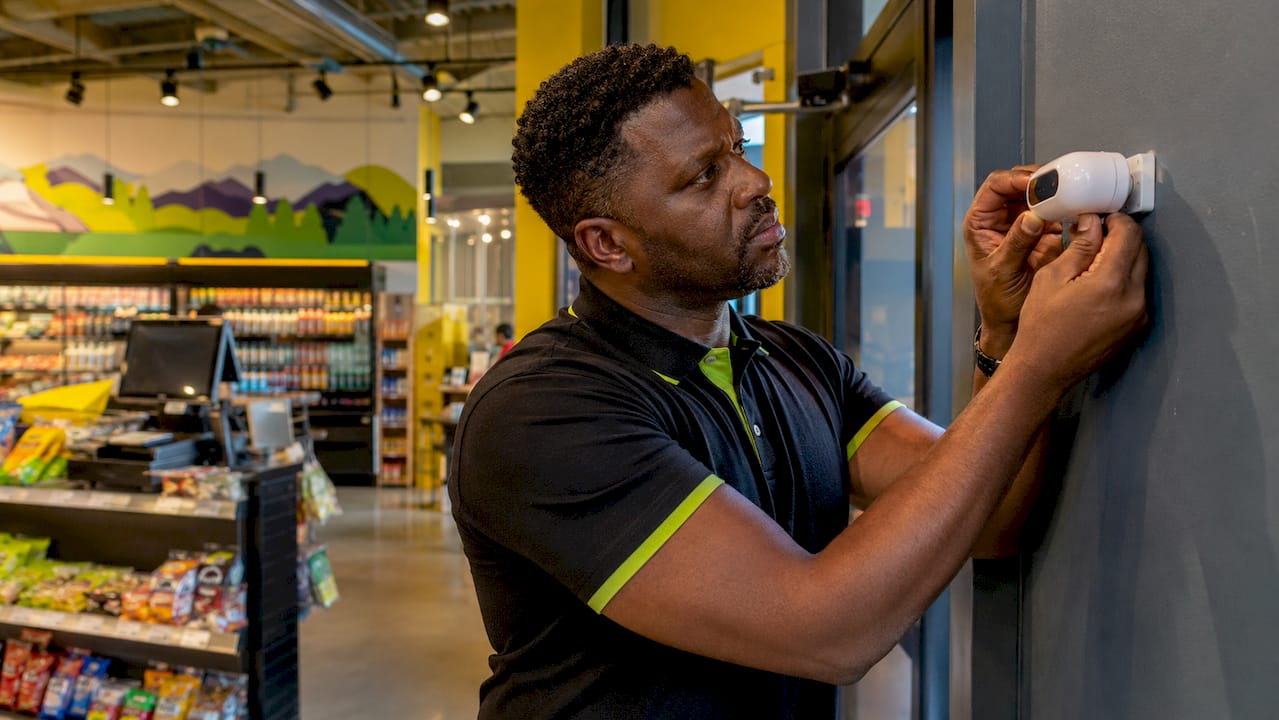
A foot traffic sensor near the entrance can trigger a welcome message on the nearest screen when traffic spikes, or switch to a slow-traffic promotion during off-peak hours. Smart shelf sensors can alert your signage system when a featured product runs low, automatically pulling the promotion before a shopper reaches an empty shelf. Beacons can push a loyalty notification to a shopper’s phone when they enter a specific aisle, connecting the physical display to a digital offer without any associate involvement.
Digital signage is the most visible output of this IoT layer, but its effectiveness depends entirely on the quality of the data feeding it. A screen showing the right message at the right moment because a sensor detected the right condition is a fundamentally different tool than a screen cycling through a pre-loaded playlist. Spectrio’s platform connects content management with audience measurement, so the data loop between what shoppers do and what screens show closes automatically.
How to handle customer feedback and complaints in-store
Feedback collected in the moment is more accurate and more useful than feedback collected days later in a survey email. The closer you get to the actual experience, the more specific and honest the response tends to be.
Place short feedback prompts at checkout: a two-question digital kiosk survey, a QR code linking to a 60-second form, or a simple thumbs-up/thumbs-down screen. Keep the ask small. A shopper who just completed a transaction will answer two questions. They will not fill out a 10-question form. Route negative responses immediately to a manager’s device so the store can respond before the shopper leaves the building.
Train associates to handle complaints with a three-step response: acknowledge the issue without deflecting, offer a specific resolution within their authority, and follow up if the resolution requires a manager. The goal is to close the loop in the same visit. A complaint resolved on the spot has a high probability of converting into a positive review. A complaint that leaves the store unresolved almost never does.
Aggregate feedback data weekly and share it with your field team alongside the engagement metrics from your signage and loyalty platforms. Patterns in negative feedback often point directly to execution failures, a sign that was not updated, a promotion that was not communicated to staff, a product that was out of stock for three days. Connecting feedback to operational data turns complaints into a diagnostic tool rather than just a customer service obligation.
Measuring ROI and long-term impact of your engagement program
The most common mistake in measuring engagement ROI is treating it as a marketing metric rather than a P&L metric. Engagement that does not show up in basket size, visit frequency, or customer lifetime value is not delivering business results, regardless of how good the click-through rate looks.
Retailers combining POS data with test-and-control methods can isolate the true impact of any engagement initiative. Run a new signage campaign in three stores, hold three comparable stores as controls, and measure the difference in average transaction value and visit frequency over four weeks. That gap, adjusted for baseline differences, is your attributable lift. It is the number you bring to your CFO, not an engagement score.
Long-term impact compounds in ways that short-term tests do not fully capture. A shopper who enrolls in your loyalty program during a well-executed checkout engagement sequence will visit more frequently, spend more per visit, and refer others at a higher rate than a shopper who was never engaged. Harvard Business Review research has consistently shown that retaining existing customers is far more cost-effective than acquiring new ones, which means every dollar invested in engagement compounds over the customer’s lifetime.
Track these metrics on a monthly cadence: loyalty enrollment rate, average basket size for enrolled versus non-enrolled shoppers, visit frequency by cohort, and net promoter score by store. When these numbers move together in the same direction, your engagement program is working. When they diverge, you have a localization or execution problem worth investigating before it spreads.
Key Takeaways
An effective in-store customer engagement strategy works through four compounding stages: Identify, Engage, Personalize, and Retain, each building on the data and relationships created by the one before it.
| Point | Details |
|---|---|
| Start at checkout | Checkout captures the most shoppers with the least infrastructure, making it the fastest source of data and early ROI. |
| One hero message per sign | Signage with a single headline of seven words or fewer and body copy under 20 words consistently outperforms cluttered displays. |
| Test before you scale | Run new campaigns in two or three stores against a control group before a full rollout to get a defensible lift number. |
| Connect POS data to engagement metrics | Combining POS data with test-and-control methods isolates the true business impact of any engagement initiative. |
| Long-term value compounds | Shoppers enrolled in a loyalty program through in-store engagement visit more often and spend more per visit over time. |
FAQ
What is an in-store customer engagement strategy?
An in-store customer engagement strategy is a system that turns anonymous store visits into personalized, measurable customer relationships through four stages: Identify, Engage, Personalize, and Retain. Each stage uses data, digital tools, and staff interactions to build loyalty and increase sales.
How do you improve customer engagement in retail?
Start by capturing customer data at checkout through digital receipts and loyalty enrollment, then use that data to personalize messaging across signage, staff interactions, and post-visit follow-ups. Aligning messaging to the shopper’s mindset by store zone, entrance for orientation, aisles for purchase decisions, consistently improves conversion.
What are the 3 C’s in retail?
The 3 C’s in retail are commonly defined as Customer, Competition, and Company, a framework for evaluating how well a retailer’s offer aligns with customer needs relative to competitors and internal capabilities. Definitions vary by source, but this framing is the most widely used in retail strategy contexts.
What is the 10/5/3 rule in customer service?
The 10/5/3 rule is a service proximity guideline: acknowledge a customer at 10 feet with eye contact, greet them verbally at 5 feet, and offer direct assistance at 3 feet. It gives store associates a simple, consistent standard for initiating engagement without waiting for the customer to ask for help first.