


Seasonal content signage is the strategic use of updated visual displays, both digital and printed, tied to cultural moments, holidays, and weather shifts to maintain customer attention and drive sales. The industry term for this practice is seasonal marketing signage, and it solves a problem every business with static displays faces: signage fade-out, the point at which a long-running display becomes invisible to regular customers. The most effective programs launch 2–4 weeks before a season peaks, with urgency building in the final 10–14 days. When you align your displays with what customers are already thinking about, your message lands instead of blending into the background.
What is seasonal content signage and why does it work?
Seasonal content signage works because it matches your message to your customer’s current mindset. A shopper walking in during december is already thinking about gifts, gatherings, and deadlines. A display that reflects that context feels relevant. One that doesn’t gets ignored.
Static displays have a near-certain tendency to fade from customer attention over time. The brain filters out familiar stimuli, a phenomenon marketers call “banner blindness.” Seasonal updates break that pattern by introducing visual novelty at predictable, high-intent moments in the calendar.

The benefits of seasonal signage extend beyond aesthetics. Updated displays signal that your business is active, attentive, and in step with what customers care about right now. That perception of relevance directly affects purchase decisions. A customer who feels your store “gets it” is more likely to browse, ask questions, and buy.
Seasonal signage also creates natural urgency. A “last chance” holiday display communicates scarcity and deadline without a single word of hard selling. That urgency, built into the visual context itself, is one of the most effective conversion tools available to marketing professionals.
How does seasonal signage boost customer engagement and sales?
The most effective seasonal signage programs use a phased campaign structure: teaser, full expression, and last chance. Each phase serves a distinct purpose and targets a different stage of the customer’s decision process.
- Teaser phase: Introduces the seasonal theme 2–4 weeks before the peak. Creates anticipation without revealing every offer.
- Full expression phase: Launches at the season’s start with complete messaging, featured products, and a clear call to action.
- Last chance phase: Runs in the final 10–14 days with urgency-focused language and limited-time framing.
A single clear message paired with one CTA consistently outperforms multi-topic signage in driving customer action. When a display tries to communicate three promotions at once, customers process none of them. One focused message gives the eye a place to land and the brain a clear next step.
Pro Tip: When building your CTA, use time-specific language tied to the season rather than generic phrases. “Shop our fall collection before October 31” outperforms “Shop now” every time. For more on crafting high-converting CTAs, the principles of specificity and urgency apply directly to signage copy.
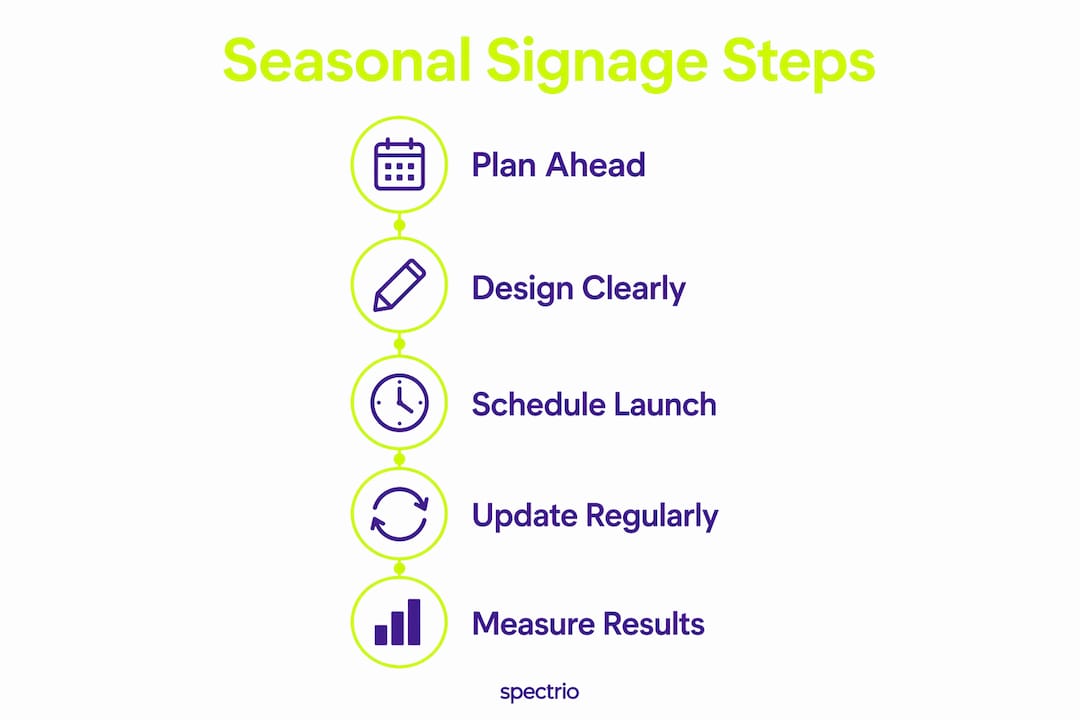
Consistent messaging across exterior and interior signage amplifies campaign effects. A customer who sees your fall theme in the window and then again at the point of sale experiences a coherent brand story. That consistency builds confidence and reduces purchase hesitation.
How to create seasonal signage that actually performs
Creating high-impact seasonal signage requires discipline in three areas: design, timing, and workflow. Most businesses get one right and neglect the other two.
Design: one message, one hierarchy
Visual hierarchy in signage follows a clear structure: large headers carry the seasonal theme, medium-sized text communicates the core benefit, and small text handles pricing or fine details. This structure guides the customer’s eye from attention to interest to action in under three seconds.
Color choices carry equal weight. Intentional color palettes in marketing trigger specific emotional responses. Warm reds and greens signal the holiday season. Bright yellows and blues communicate summer energy. Choosing colors that align with both the season and your brand identity creates displays that feel both timely and familiar.
Timing: work backward from your target date
- Set your peak date. Identify the exact day or week you want maximum foot traffic or sales.
- Schedule your last-chance phase. Count back 10–14 days from the peak for urgency messaging.
- Schedule your full expression launch. Count back another 1–2 weeks for your main campaign rollout.
- Schedule your teaser. Launch 2–4 weeks before full expression to build awareness.
- Set your production deadline. Planning often starts months in advance, typically in the preceding season, to accommodate design, prototyping, manufacturing, and shipping.
Pro Tip: Build a master seasonal calendar at the start of each year. Map every major retail moment, from back-to-school in july through the winter holidays, and assign production start dates to each. Missing a production window by two weeks can cost you the entire teaser phase.
Workflow: modular updates over full redesigns
Evergreen display bases with modular seasonal updates, such as magnetic toppers, decals, or interchangeable panels, reduce labor and material costs while keeping your brand consistent year-round. You invest once in a quality base structure and update the seasonal layer each quarter. This approach makes seasonal display strategies financially sustainable for businesses of any size.
What are examples of seasonal content signage across industries?
Seasonal content examples vary widely by industry, but the underlying logic stays the same: align the visual environment with what customers are already anticipating.
- Retail: Back-to-school displays in late july feature bold typography, supply checklists, and bundle pricing. Holiday window displays in november use warm lighting and gift-focused messaging to drive foot traffic before the peak shopping weekend.
- Restaurants and bars: Summer menus displayed on digital boards rotate featured cocktails and outdoor dining promotions. Lighting mood shifts, such as warm amber tones for winter and bright white for summer, improve how food and drinks look in photos and in person.
- Fitness and wellness: January signage targets resolution-driven new members with transformation messaging. Spring campaigns shift to outdoor fitness and weight-loss goals as the weather changes.
- Healthcare and pharmacy: Flu season displays in october promote vaccines and wellness products. Spring allergy season triggers a predictable shift to antihistamine promotions and symptom-relief messaging.
The format matters as much as the content. Outdoor signage needs high contrast and weather-resistant materials. Indoor digital displays allow for rapid content swaps without print costs. Printed vs. digital signage each carry trade-offs in cost, flexibility, and production time that your seasonal calendar should account for.
| Seasonal moment | Signage type | Core message focus |
|---|---|---|
| Back-to-school (july–august) | Indoor printed and digital | Bundle deals, supply lists, urgency |
| Fall sports season (september) | Outdoor banners, digital boards | Team spirit, food and beverage promotions |
| Holiday season (november–december) | Window displays, digital, in-store | Gift guides, limited-time offers |
| New Year (january) | Digital and printed interior | Resolutions, memberships, fresh starts |
| Summer (june–august) | Outdoor and digital | Seasonal products, outdoor experiences |
Interactive elements add another layer of engagement. Touchscreen kiosks that let customers browse seasonal gift guides or configure custom orders extend the time spent with your brand and increase average transaction value.
How do you measure the effectiveness of seasonal signage campaigns?
Measurement turns seasonal signage from a creative exercise into a business decision. The three core metrics are foot traffic, sales uplift, and customer engagement rates.
- Foot traffic: Compare daily or weekly visitor counts during the campaign period against the same period in the prior year. A meaningful lift confirms the signage is drawing people in.
- Sales uplift: Track revenue for featured seasonal products against baseline performance. If your holiday gift bundle display runs for three weeks, compare those three weeks to the three weeks before the display launched.
- Customer engagement: For digital displays, track dwell time and interaction rates. For printed signage, use staff observation and customer feedback to assess which displays prompt questions or comments.
Consistent messaging across all signage types amplifies campaign effects and makes measurement cleaner. When every touchpoint, from the exterior window to the checkout counter display, carries the same seasonal theme, you can attribute performance changes to the campaign rather than to unrelated variables.
Qualitative feedback from your team is underused and undervalued. Staff who interact with customers daily know which displays prompt questions, which ones get ignored, and which ones generate confusion. That ground-level intelligence refines your next seasonal rollout faster than any analytics dashboard. Building a content strategy that incorporates both quantitative and qualitative feedback closes the loop between creative decisions and business outcomes.
Key Takeaways
Seasonal content signage drives measurable results when it combines focused messaging, phased timing, and consistent visual identity across every customer touchpoint.
| Point | Details |
|---|---|
| Launch timing matters | Start seasonal campaigns 2–4 weeks before peak dates, with urgency messaging in the final 10–14 days. |
| One message wins | A single campaign message paired with one CTA outperforms multi-topic displays in driving customer action. |
| Plan production early | Seasonal timelines often start months ahead to cover design, manufacturing, and installation without delays. |
| Modular updates save money | Evergreen display bases with seasonal overlays reduce costs while keeping brand identity consistent year-round. |
| Measure all three metrics | Track foot traffic, sales uplift, and engagement rates to refine each seasonal campaign based on real data. |
Spectrio’s take on what most businesses get wrong with seasonal signage
The most common mistake we see is not poor design. It’s poor timing. Businesses finalize their holiday creative in the first week of december, which means they miss the teaser phase entirely and launch their full campaign with less than two weeks until the peak. By then, customers have already made most of their purchasing decisions.
The second mistake is treating seasonal signage as a one-time project rather than a system. Every season is a separate scramble: new brief, new vendor conversation, new approval chain. That approach burns time and budget. The businesses that get the most from seasonal marketing signage treat it as a repeatable program with a master calendar, a modular asset library, and a production schedule that starts in the preceding quarter.
There is also a tendency to overcrowd displays. A holiday window that tries to feature twelve products, a loyalty program reminder, store hours, and a social media handle communicates nothing. Ruthless editing, as visual design professionals put it, is not a creative preference. It is a conversion requirement. Every element that does not support the single campaign message is working against it.
Seasonal signage fits inside a broader omnichannel strategy, not outside it. Your in-store displays should reflect what your email campaigns are saying, what your social posts are showing, and what your website landing pages are featuring. When those channels align, the seasonal moment feels like a coordinated experience rather than a collection of disconnected promotions. That coherence is what turns a seasonal display into a customer engagement tool with real ROI.
— Spectrio
How Spectrio supports your seasonal signage program
Seasonal campaigns move fast, and your signage system needs to keep up.

Spectrio’s digital signage platform lets you schedule seasonal content weeks in advance, swap creative instantly when a campaign phase changes, and manage displays across multiple locations from a single dashboard. Flexible templates maintain your brand identity while giving your team the speed to update messaging without a full production cycle. Whether you are running a three-phase holiday campaign or a quick summer promotion, Spectrio gives you the tools to manage content at scale without the last-minute scramble. See how businesses are using unique digital signage applications to make every season count.
FAQ
What is seasonal content signage?
Seasonal content signage is the practice of updating visual displays, both digital and printed, to reflect specific times of year, holidays, or cultural moments. The goal is to maintain customer attention, signal business relevance, and drive timely purchasing decisions.
When should seasonal signage launch?
Effective seasonal signage launches 2–4 weeks before a season’s peak, with urgency-focused messaging running in the final 10–14 days. Planning and production typically begin months earlier to avoid delays.
What makes seasonal signage effective?
A single clear message paired with one call to action consistently outperforms multi-topic displays. Strong visual hierarchy, intentional color choices, and consistent messaging across all locations amplify results.
How do you measure seasonal signage ROI?
Track foot traffic, sales uplift on featured products, and customer engagement rates during the campaign period. Compare results against the same period in the prior year to isolate the campaign’s impact.
What is the difference between printed and digital seasonal signage?
Printed signage offers durability and lower upfront cost for static locations, while digital signage allows rapid content updates, remote scheduling, and phased campaign management without reprinting costs.