



Personalized content is defined as marketing material tailored to a specific audience segment based on behavior, intent, source, or awareness level. Understanding how personalized content improves conversion is now a core competency for marketing professionals, not a nice-to-have. Copy-driven personalization that matches messaging to market awareness levels produces 50–200% conversion lifts over generic content. That range is not theoretical. It reflects what happens when the right message reaches the right person at the right moment in their buying process.
How does personalized content improve conversion rates?
Personalized content drives conversion by removing the friction that causes visitors to leave without acting. When a prospect lands on a page and the headline speaks directly to their situation, they do not need to work to understand why the offer is relevant. That cognitive ease translates directly into higher action rates.

Personalized CTAs outperform generic versions by 202%. That single data point reframes how you should think about your call-to-action copy. A button that says “Get My Free Audit” for a visitor who arrived from a paid search ad about SEO will always outperform a generic “Learn More.”
The mechanisms behind this lift include:
- Relevance matching: Tailored headlines and visuals confirm to the visitor that they are in the right place, reducing bounce rates immediately.
- Buyer journey alignment: A first-time visitor needs different messaging than a returning prospect who has already read your case studies.
- Segment-specific social proof: A retail brand showing a testimonial from a retailer converts better with retail visitors than a generic enterprise quote.
- Reduced decision friction: When content meets an immediate need, visitors convert naturally without feeling pushed.
Pro Tip: Start with your highest-traffic landing page. Identify the top two or three traffic sources, then write a unique headline for each source. This single change often produces the fastest measurable lift.
Why does copy-driven personalization outperform surface-level tactics?
Most marketers think of personalization as inserting a first name into an email subject line. That is surface-level personalization, and it produces surface-level results. Copy-driven personalization goes deeper. It rewrites the entire message arc to match where a specific segment sits in their awareness of the problem and the solution.
Direct-response copywriting research confirms that message-to-market match is the single most powerful lever in conversion rate optimization. A prospect who is problem-aware needs different language than one who is already solution-aware and comparing options. Sending both the same copy wastes the opportunity.
The compounding effect of consistent personalization across the full buyer journey is significant. Here is how to build that consistency:
- Audit your traffic sources. Identify where visitors come from and what intent each source signals.
- Map awareness levels. Categorize segments as unaware, problem-aware, solution-aware, or product-aware.
- Write source-specific headlines. Match the ad or email copy to the landing page headline so the message feels continuous.
- Personalize objection handling. Address the specific doubts each segment carries, not a generic FAQ.
- Align email follow-up sequences. The post-conversion nurture should reflect what the visitor originally responded to.
Personalization compounds across the buyer journey when each touchpoint reinforces the last. A visitor who clicks a paid ad, lands on a matched page, and receives a follow-up email that references their original interest converts at a measurably higher rate than one who experiences a disconnected sequence.
Pro Tip: Fix your core offer and headline before adding personalization technology. Headline and CTA copy changes account for 60–70% of the total conversion lift from a fully personalized page. Technology amplifies a strong message. It cannot rescue a weak one.
What role does AI play in scaling personalized content?
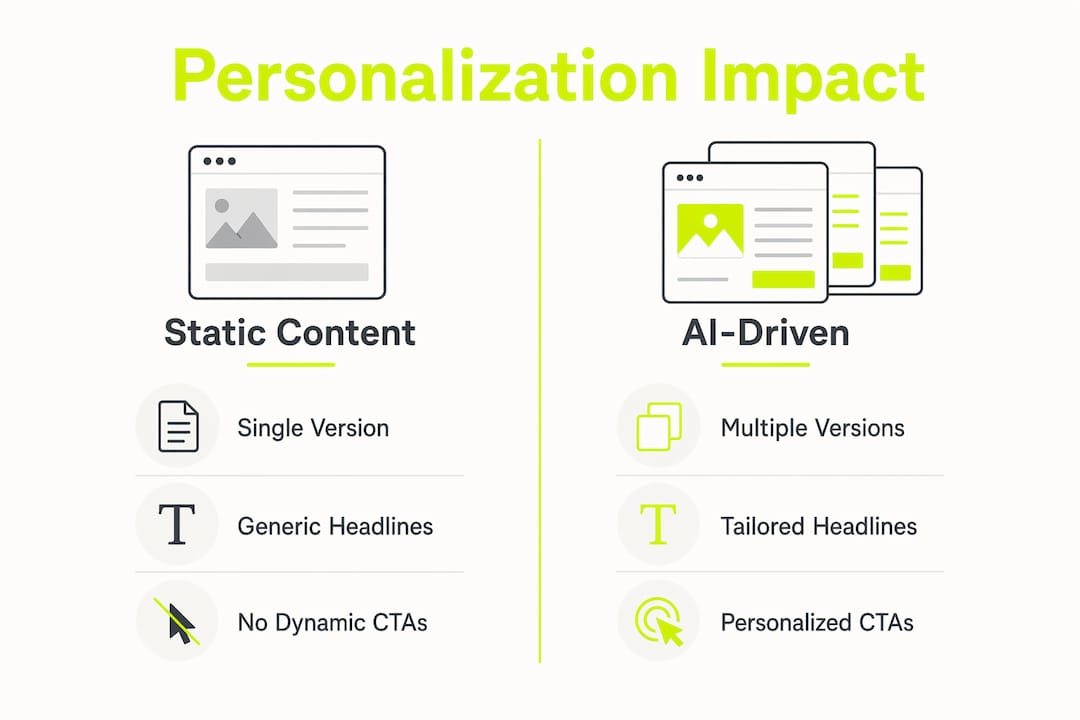
Artificial intelligence makes personalization practical at scale. Without AI, writing unique content variations for every segment, source, and device type would require a team too large for most marketing budgets. AI changes that equation by generating and serving dynamic content variations in real time.
AI-driven personalization yields 20–40% higher conversions compared to static pages. The mechanism is straightforward: AI reads signals such as device type, referral source, geographic location, and on-site behavior, then serves the content variation most likely to convert that specific visitor.
The table below shows how AI-driven personalization compares to static content across key performance dimensions:
| Dimension | Static content | AI-driven personalization |
|---|---|---|
| Headline variation | One version for all visitors | Dynamic, matched to source or segment |
| CTA copy | Fixed across the page | Adapted to visitor intent signals |
| Social proof | Generic testimonials | Segment-relevant case studies |
| Conversion rate lift | Baseline | 20–40% above baseline |
| Scalability | Limited by team capacity | Scales with data volume |
One limitation marketers consistently underestimate is content availability. AI can only serve variations that exist. Content availability limits personalization scalability more than AI sophistication does. Building a library of high-quality content variations is the prerequisite that makes AI personalization work. First-party data is equally critical. As third-party cookies continue to phase out, behavioral and transactional data you collect directly from your audience becomes the fuel that powers accurate personalization.
Algorithmic personalization also drives engagement beyond direct conversion. One 2026 study found that algorithmic personalization increased shares by 2.3x and comments by 1.8x compared to editorially curated content. Higher engagement signals feed back into your distribution algorithms, extending organic reach without additional spend.
What are the risks of over-personalization?
Personalization produces measurable gains, but aggressive targeting carries real risks. The trust-engagement disconnect is the most important one to understand. Overly aggressive AI personalization risks eroding brand trust despite short-term engagement gains. Visitors who feel tracked too closely disengage or, worse, develop a negative association with your brand.
The risks worth managing include:
- Creepiness threshold: Referencing data points a visitor did not knowingly share crosses from helpful to intrusive. Personalize based on what visitors have actively told you, not just what you have inferred.
- Editorial integrity: Over-automation can strip your content of the voice and perspective that built your audience’s trust in the first place.
- Privacy compliance: Regulations such as GDPR and CCPA require explicit consent for data collection. First-party data collected transparently is both more compliant and more accurate than third-party data.
- Short-term vs. long-term balance: A tactic that lifts this month’s conversion rate but damages brand perception costs more in the long run than it earns.
The practical solution is to set clear rules for what data you use and how visible that use is to the visitor. Personalization that feels like good service converts and retains. Personalization that feels like surveillance repels.
How can you implement a personalization strategy that actually works?
Building a personalization program does not require enterprise-level technology on day one. Simple rule-based personalization tactics like showing returning visitors tailored content or matching landing pages to paid campaigns produce measurable conversion uplift without advanced AI. Start there, prove the ROI, then invest in more sophisticated tools.
A practical implementation path looks like this:
- Segment by behavior first. Returning visitors, cart abandoners, and first-time visitors from organic search each need different messaging. Build those three segments before anything else.
- Match campaign landing pages. Every paid ad should point to a page whose headline mirrors the ad copy. This alone reduces bounce rates and improves Quality Score in paid search.
- Use returning visitor signals. Show someone who has already read your pricing page a different homepage message than a first-time visitor. This requires minimal technology and delivers clear results.
- Test one variable at a time. Run A/B tests on headlines before testing CTA copy. Isolating variables gives you clean data on what is actually driving lift.
- Measure segment-level conversion rates. Aggregate conversion rates hide what is working. Break performance down by segment to see where personalization is earning its keep.
Personalization programs that increase revenue by 25% year-over-year share one characteristic: they treat personalization as a system, not a campaign. The impact of personalized content compounds when every touchpoint reinforces the same message. Build the system, then let the data tell you where to invest next.
Key Takeaways
Personalized content improves conversion by matching message to audience intent, with copy-driven changes and AI personalization delivering the largest and most measurable lifts.
| Point | Details |
|---|---|
| Copy drives the most lift | Headline and CTA changes account for 60–70% of total conversion gains from personalization. |
| Personalized CTAs convert far better | Personalized CTAs outperform generic versions by 202%, making copy the highest-ROI personalization lever. |
| AI scales what copy starts | AI-driven personalization delivers 20–40% higher conversions, but only when content variations already exist. |
| Over-personalization erodes trust | Aggressive targeting boosts short-term engagement but risks long-term brand credibility if not managed carefully. |
| Start simple, then scale | Rule-based personalization for returning visitors and campaign-matched pages produces real lift before any AI investment. |
The uncomfortable truth about personalization most marketers ignore
I have reviewed hundreds of personalization programs, and the pattern is consistent. Marketers invest in personalization technology before they have a message worth personalizing. They add dynamic content blocks to a landing page whose core value proposition is still vague. They personalize the name token in an email sequence that nobody would read twice regardless of how it was addressed.
The data is clear on this. Headline and CTA copy improvements deliver the majority of conversion lift. That means the most valuable personalization work is a writing problem, not a technology problem. Before you evaluate any personalization platform, ask whether your best copywriter has spent serious time on your highest-traffic pages. If the answer is no, start there.
The second mistake I see consistently is treating personalization as a one-time project. A segment that converts well in Q1 may behave differently by Q3 as market conditions shift. The marketers who sustain year-over-year revenue growth from personalization treat it as an ongoing editorial practice, not a technical implementation they can set and forget.
The 5 elements of engaging content apply whether you are writing for a digital screen or a landing page. Relevance, clarity, and a clear next step are not personalization features. They are the foundation that personalization builds on.
How Spectrio helps you put personalization to work
Personalization works best when it reaches customers at every touchpoint, including the physical spaces where they spend time with your brand. Spectrio’s Intelligent Engagement Suite connects digital signage, interactive kiosks, and scent marketing into a single system that delivers tailored messages based on audience, location, and time of day.
For marketing professionals who want to extend personalization beyond the screen and into the in-store experience, Spectrio’s audience measurement capabilities track engagement and feed that data back into content decisions. The result is a feedback loop that improves over time. If you are thinking about unique ways to use digital signage as part of a broader personalization strategy, Spectrio’s team can walk you through what is working across retail, hospitality, and service environments right now.
FAQ
What is content personalization in marketing?
Content personalization is the practice of tailoring marketing messages, visuals, and offers to specific audience segments based on behavior, intent, or awareness level. It goes beyond inserting a name into an email and includes matching headlines, CTAs, and social proof to each segment’s specific needs.
Does personalization actually increase sales?
Yes. Copy-driven personalization produces 50–200% conversion lifts over generic messaging, and personalized CTAs outperform generic versions by 202%. These gains reflect real revenue impact, not just engagement metrics.
How does AI improve personalized content?
AI enables real-time dynamic content, serving different headlines, images, and CTAs to different visitors based on behavioral signals. AI-driven personalization yields 20–40% higher conversions compared to static pages, provided sufficient content variations exist to serve.
What is the biggest risk of personalization?
The primary risk is the trust-engagement disconnect. Overly aggressive targeting can boost short-term engagement while eroding long-term brand trust. Marketers should personalize based on data visitors have knowingly shared and maintain editorial integrity in their content.
Where should marketers start with personalization?
Start with rule-based personalization: match landing pages to paid ad copy and show returning visitors different messaging than first-time visitors. These low-complexity tactics produce measurable conversion uplift before any AI investment is required.