


24/7 signage support is the continuous, expert service that keeps digital signage systems operational, maintained, and effective around the clock. For large venues and multi-location organizations, it means having trained technicians, centralized helpdesk coordination, and emergency response capabilities available at any hour. A single display failure in a flagship retail location, airport terminal, or hospital lobby is not a minor inconvenience. It is a direct hit to revenue, brand credibility, and in some cases, safety compliance. Spectrio builds this level of around-the-clock signage service into its core offering because the cost of downtime is simply too high to accept.
What is 24/7 signage support and what does it include?
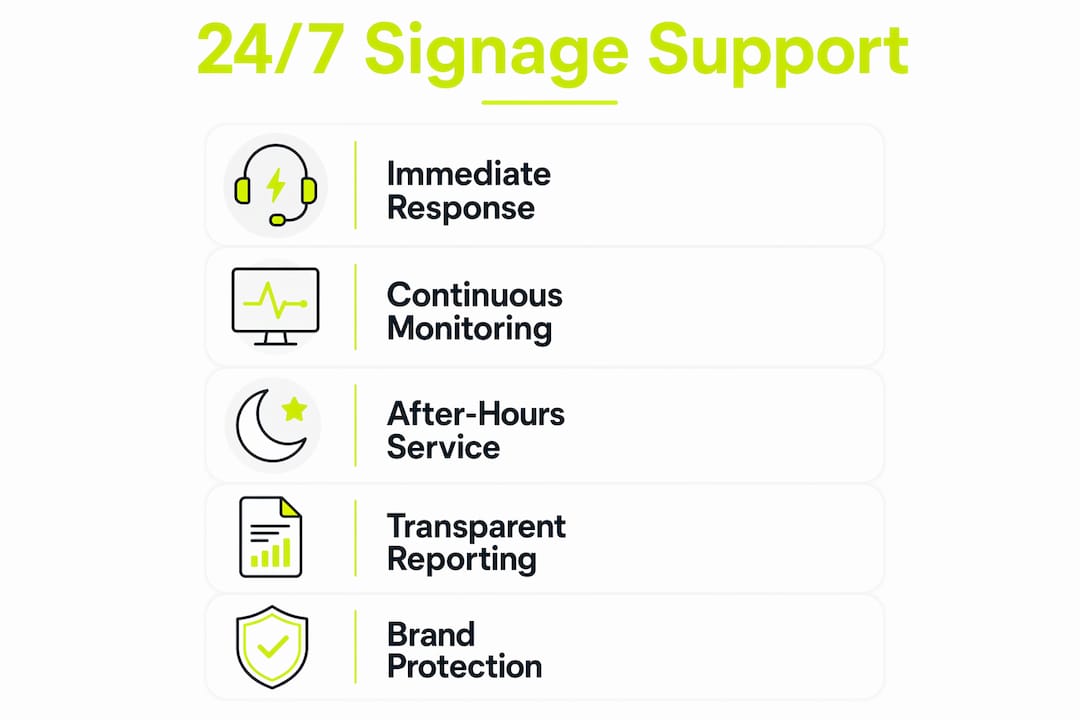
24/7 signage support is the industry term for continuous, expert-backed maintenance and response services for digital signage networks. It covers far more than fixing a broken screen. A complete 24/7 signage service includes the following core capabilities:
- Immediate troubleshooting and repair response. When a display goes dark or a media player fails, a support team dispatches a technician or initiates remote diagnostics without waiting for business hours to begin.
- Preventative maintenance scheduling. Routine inspections, firmware updates, and hardware checks happen on a planned cycle. This reduces the probability of unexpected failures during peak operating hours.
- Emergency response for urgent issues. Storm damage, code violations, and safety hazards require fast, on-site fixes. Emergency response teams provide 24/7 access support to keep signage functional and compliant in high-impact environments.
- Centralized helpdesk and dispatch coordination. A single point of contact for tracking and resolving maintenance tickets is essential for multi-location businesses that need brand consistency and accountability across every site.
- Remote monitoring and proactive detection. Technicians use monitoring tools to identify issues before they become failures. This shifts support from reactive to preventative, which is where the real operational value lives.
- Detailed documentation and reporting. High-resolution photos and time-stamped records confirm that work was completed correctly, giving site managers verifiable proof even when repairs happen overnight.
Pro Tip: Ask any prospective support provider to show you a sample overnight work report. If they cannot produce one with photos and timestamps, their documentation process is not mature enough for a multi-location operation.
How does 24/7 signage support benefit large venues?
Zero downtime is now a critical requirement in high-density retail and public venues to avoid costly revenue interruptions. That single fact reshapes how large organizations should think about signage maintenance.
The benefits of around-the-clock signage support fall into five clear categories:
- Revenue protection. After-hours repair teams operate with full equipment and backup kits, completing work at 3:00 AM so daytime operations are never disrupted. Avoiding a single day of store closure for repairs can save thousands of dollars in lost sales.
- Brand consistency across locations. Every screen in every location needs to display the right content at the right time. Centralized maintenance tracking and follow-up keeps all sites aligned with brand standards, which directly supports long-term growth. Research on brand consistency confirms that uniform presentation across touchpoints is one of the strongest drivers of customer trust.
- Safety and regulatory compliance. Damaged or non-compliant signage creates legal exposure. Emergency teams handle code violation responses and secure takedowns, keeping your organization on the right side of local regulations.
- Reduced in-house burden. Outsourcing signage maintenance to expert providers removes the cost and complexity of building an internal repair team. Your facilities staff focuses on core operations instead of chasing down display malfunctions.
- Sustained marketing effectiveness. Digital signage only delivers ROI when it is working. A screen that is dark or frozen is not just a maintenance problem. It is a marketing failure. Continuous support keeps your messaging live and your audience engaged.
Commercial integration experts describe 24/7 support as the mechanism that preserves the value of signage investments. That framing is accurate. You are not just buying uptime. You are protecting the return on every dollar spent on content, hardware, and installation.
What distinguishes 24/7 signage support from standard support models?
Standard support models operate on business hours, typically 9:00 AM to 5:00 PM, Monday through Friday. A display failure at 11:00 PM on a Saturday sits unresolved until Monday morning. For a hotel lobby, a sports arena, or a 24-hour retail chain, that gap is unacceptable.
True 24/7 signage service is defined by three structural differences from conventional support.
Continuous expert availability
Standard models route after-hours calls to voicemail or a basic answering service. A genuine 24/7 model connects you to a trained technician who can begin remote diagnostics or dispatch a crew immediately. The distinction is not just about hours. It is about the quality of response at any hour.
No-fail preparation for after-hours work
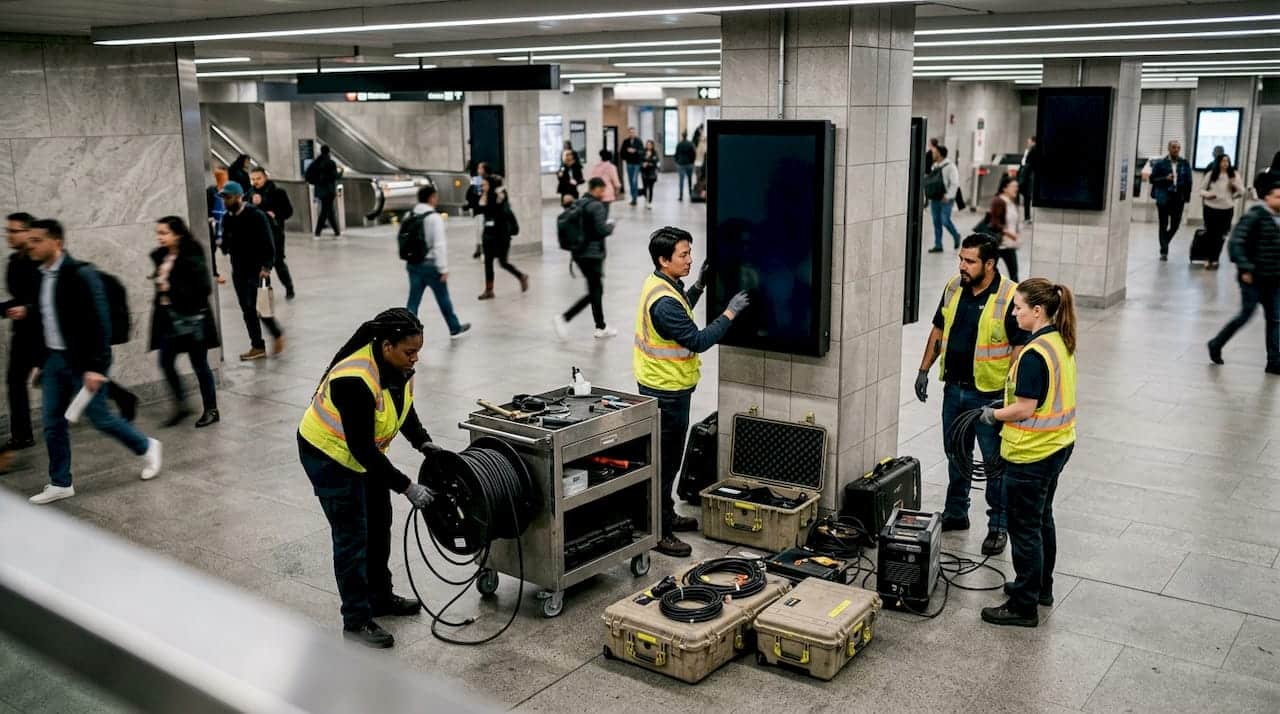
Professional signage installers and support crews adopt a no-fail mentality for overnight work. Crews bring comprehensive backup kits and specialized tools because they cannot rely on supply stores or external support at 2:00 AM. This level of preparation is absent from standard support models, which assume problems can wait.
Transparent documentation as a standard practice
Standard support often provides a work order number and a verbal confirmation. Top-tier 24/7 providers deliver detailed overnight documentation with photos and timestamps, giving managers verifiable proof of completed tasks. That transparency is not a premium add-on. It is the baseline expectation for any serious 24/7 signage service.
Pro Tip: When reviewing a provider’s SLA, look specifically for language about after-hours response time, not just overall response time. A four-hour SLA that only applies during business hours is not a 24/7 commitment.
How to evaluate a 24/7 signage support provider
Choosing the right provider for immediate signage assistance requires more than comparing price sheets. The following criteria separate capable providers from those who will leave you exposed during a critical failure.
- Response time guarantees. The SLA must specify maximum response times for after-hours emergencies, not just standard tickets. Any ambiguity here is a red flag.
- Technician expertise and certification. Ask about training standards and whether technicians carry manufacturer certifications for the hardware in your network.
- National or regional coverage. National mobilization and vendor networks enable rapid crew deployment across multiple sites. If your organization spans several states, your provider must match that footprint.
- Integration with your existing hardware and software. A provider unfamiliar with your content management system or display hardware will waste time on every service call. Confirm compatibility before signing.
- Centralized issue tracking. You need a portal or reporting system that shows open tickets, resolution times, and completed work across all locations. Without it, you are managing support blindly.
- Emergency response experience. Ask for documented examples of after-hours emergency responses, including storm damage or compliance issues. Experience in high-pressure situations is not something a provider can fake.
Pro Tip: Request a reference from a client with a similar number of locations and a comparable signage footprint. A provider who excels at managing 10 locations may not have the logistics to handle 200.
Audience engagement strategies built on reliable signage networks require a support infrastructure that matches the ambition of your marketing program. The provider you choose either enables that ambition or limits it.
Key Takeaways
24/7 signage support is the operational foundation that keeps digital signage networks profitable, compliant, and brand-consistent across every location at every hour.
| Point | Details |
|---|---|
| Continuous availability matters | After-hours failures need immediate response, not a Monday morning callback. |
| Documentation is non-negotiable | Time-stamped photos and overnight reports verify work and protect accountability. |
| Brand consistency depends on it | Centralized maintenance tracking keeps all locations aligned with brand standards. |
| Provider coverage must match your footprint | National networks with vetted technicians are required for multi-location organizations. |
| SLAs must specify after-hours terms | A response time guarantee that only covers business hours is not a 24/7 commitment. |
Why I think most organizations underestimate signage support until it’s too late
The businesses that invest in 24/7 signage support before a crisis are the ones that treat signage as a revenue-generating asset, not a utility. The ones that wait until a flagship display goes dark on a Friday night at 8:00 PM learn the hard way that reactive support is always more expensive than proactive support.
What I have observed across high-traffic retail and venue environments is that signage downtime rarely happens at a convenient time. It happens during a product launch, a holiday weekend, or a major event. Those are precisely the moments when your signage carries the most weight and when a failure does the most damage.
The evolution of signage support technology has been significant. Remote monitoring tools now catch hardware degradation before it causes a failure. Content management platforms flag scheduling errors in real time. But technology alone does not replace the human judgment required to prioritize an emergency, coordinate a crew, and communicate clearly with a site manager at midnight. The best providers combine both.
My strongest recommendation is to treat the support relationship as a partnership, not a transaction. Schedule quarterly reviews with your provider. Review resolution time data. Push for continuous improvement on documentation quality. The providers who welcome that scrutiny are the ones worth keeping.
How Spectrio supports your signage network around the clock
Spectrio’s digital signage solutions include dedicated account teams and round-the-clock support designed for organizations that cannot afford gaps in their signage operations.

Spectrio works with large venues and multi-location businesses to keep signage networks running, content current, and brand messaging consistent across every screen. Whether you manage a single flagship location or hundreds of sites nationwide, Spectrio’s support infrastructure is built to match your scale. For a closer look at how digital signage can work harder for your business with the right support behind it, Spectrio’s team is ready to help you build a plan that fits your operation.
FAQ
What is 24/7 signage support?
24/7 signage support is continuous, expert-backed maintenance and emergency response for digital signage systems, available at any hour. It includes remote monitoring, on-site repair dispatch, preventative maintenance, and detailed documentation.
How does 24/7 signage service differ from a standard warranty?
A warranty covers manufacturing defects. A 24/7 signage service covers operational failures, content issues, emergency repairs, and proactive maintenance across your entire network, regardless of cause or time of day.
Why do large venues need around-the-clock signage support?
Large venues operate outside standard business hours and cannot afford display failures during peak traffic periods. After-hours teams with full equipment kits resolve issues overnight so daytime operations are never disrupted.
What should an SLA for signage maintenance services include?
A strong SLA specifies maximum response times for after-hours emergencies, uptime guarantees, documentation requirements, and escalation procedures for critical failures. Vague language around response windows is a warning sign.
How does 24/7 signage support protect brand consistency?
Centralized helpdesk coordination and standardized maintenance protocols keep every location displaying the correct content at the correct time. Providers with rapid dispatch networks and vetted technicians resolve issues before they affect customer-facing messaging.