


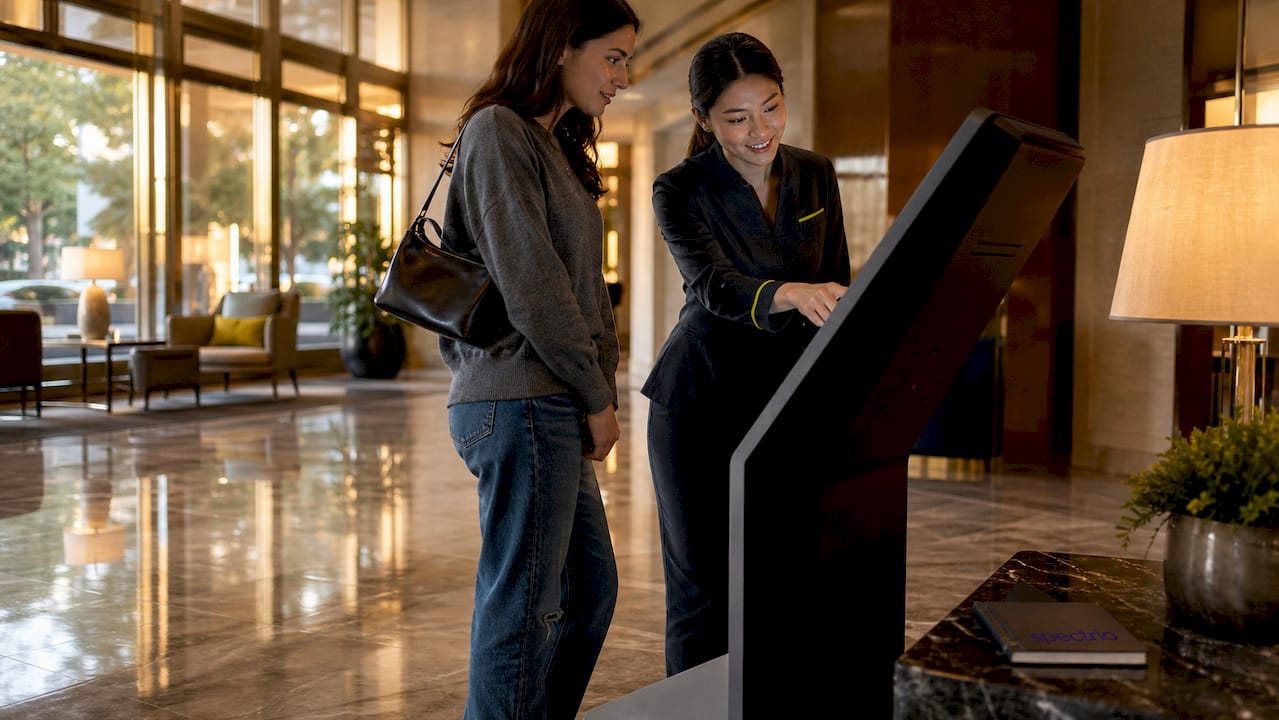
Digital signage in hospitality is defined as the use of dynamic, networked displays throughout hotel and resort properties to improve guest engagement, reduce operational friction, and increase revenue. The role of digital signage in hospitality goes far beyond decorative screens. Properties that deploy integrated display ecosystems report measurable gains in guest satisfaction, staff efficiency, and on-property spend. Guests form a lasting brand impression within 8 seconds of entry, which means every screen in your lobby is either earning its place or wasting it.
How does digital signage improve guest navigation and reduce staff workload?
Interactive wayfinding is the most immediate operational win digital signage delivers. Wayfinding displays reduce directional inquiries to front desk staff by 30%–40%. That is not a marginal improvement. It frees your team to focus on check-ins, concierge requests, and guest recovery instead of pointing people toward the elevator.
The efficiency gains compound when signage connects to your property management system (PMS). Real-time data feeds keep wayfinding accurate during events, renovations, or room reassignments. A guest heading to a conference room that was moved gets the correct directions automatically, without a staff member making a phone call or reprinting a sign.
Front desk congestion drops by up to 40% when interactive navigation displays combine with digital check-in. That reduction directly improves the arrival experience, which sets the tone for the entire stay.
Key operational benefits of guest-facing wayfinding signage include:
- Lobby kiosks that display floor maps, room directories, and event schedules
- Elevator bank screens that show real-time floor-by-floor information
- Corridor displays that provide contextual messaging based on location
- Event signage that updates automatically when schedules change
Pro Tip: Place interactive kiosks at the three highest-traffic decision points in your property: the main entrance, the elevator lobby, and the conference center entrance. These locations capture guests at the exact moment they need directional help.
In what ways does digital signage increase hotel and hospitality revenue?
Digital signage is a direct revenue tool, not just an operational one. The financial case is clear when you break it down by revenue stream.
- Food and beverage upsells. Digital menu boards in restaurants, bars, and room service areas increase average check size. Rotating promotions for happy hour specials, chef features, or dessert add-ons reach guests at the point of decision.
- Third-party advertising. Lobby and corridor screens can carry paid placements from local attractions, transportation services, and retail partners. This creates a revenue stream that offsets your signage investment.
- Spa and amenity promotion. Screens near the pool or fitness center promote spa bookings and activity packages to guests who are already in a receptive mindset.
- Event and meeting room upsells. Conference area displays can promote catering upgrades, AV packages, and extended booking options directly to event organizers.
- Printing cost elimination. Every digital menu board, event directory, and promotional poster replaces printed materials that require design, printing, and distribution costs.
Digital signage investments typically yield ROI within 12–18 months from upselling, reduced printing costs, and advertising revenue combined. That timeline shortens when properties treat signage as a revenue channel from day one rather than an infrastructure cost.
Stat to know: Properties that advertise local amenities on in-house signage generate revenue streams that directly offset their initial investment. The screens pay for themselves while improving the guest experience simultaneously. You can explore how to measure signage ROI in detail to build your own financial case before committing to a deployment.
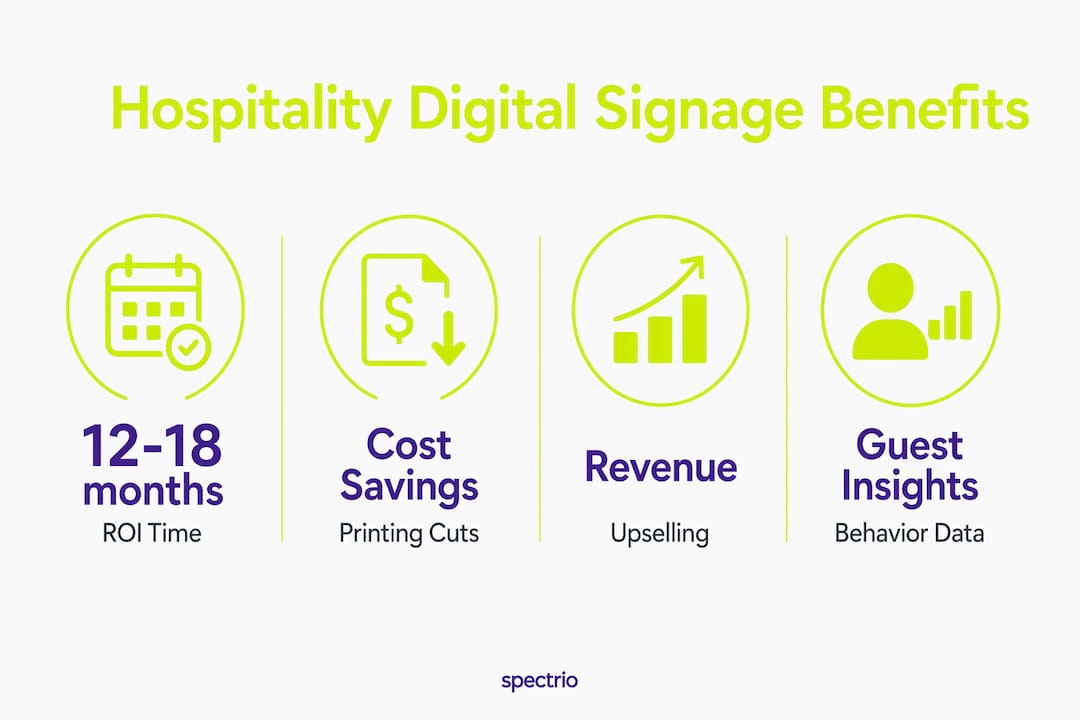
Data-driven signage solutions increasingly provide insights on guest behavior and device health, helping properties fine-tune content to maximize both engagement and revenue per screen.
What technology and integration best practices maximize signage effectiveness?
The hardware decision matters more in hospitality than in almost any other vertical. Standard consumer televisions are not an option for in-room displays. Pro:Idiom-encrypted hospitality TVs are required by content providers for protected programming. These purpose-built displays also support master remote control, branded welcome screens, volume limits, and energy-saving modes that consumer sets cannot provide.
For public-area displays, the integration architecture is what separates effective deployments from expensive screen installations. Properties that connect signage to their PMS benefit from real-time automation: room readiness displays, personalized welcome messages, and event directory updates that require no manual intervention. API connections to booking systems and event platforms keep content accurate without adding staff workload.
Failure to synchronize signage messaging across multiple platforms produces inconsistent brand experiences that frustrate guests. A guest who sees one event schedule in the lobby and a different one outside the ballroom loses confidence in your property’s competence.
The content management system (CMS) is the governance layer that prevents this. Group hotel chains use centralized CMS platforms with role-based permissions to maintain brand consistency while allowing localized content updates at each property. A regional marketing manager can push brand-approved templates, while a property-level coordinator updates daily specials without touching the brand assets.
Pro Tip: Before selecting a CMS, map every content update your team makes in a typical week. If your team manually updates more than five content types, you need a platform with PMS and event API integration. Manual updates are where brand consistency breaks down.
Successful deployments treat the hotel as a connected ecosystem. Systems like Samsung LYNK SINC and LG Pro:Centric integrate public zone signage with in-room displays, creating a unified guest experience from the lobby screen to the television in the room. Visual storytelling consistency across every touchpoint reinforces brand identity, and strong visual storytelling directly improves how guests perceive and remember your property.
How can hospitality properties use digital signage across guest touchpoints?
Every zone in your property serves a different guest need. Signage content must match the context of each location to be useful rather than ignored.
Strategic zoning of digital signage across lobby, elevator banks, conference areas, restaurants, and pools maximizes guest interaction by matching content to location. A guest at the pool does not need conference room directions. A guest in the elevator at 7:00 AM wants breakfast hours, not spa promotions.
- Lobby video walls capture the first impression and communicate brand identity immediately. Use them for welcome messaging, local weather, and property highlights rather than generic stock footage.
- Elevator and corridor screens are high-frequency touchpoints. Guests see them multiple times per day. Rotate content that promotes daily specials, events, and amenities on a time-of-day schedule.
- Conference and event signage serves a professional audience with specific needs. Real-time schedule updates, room assignments, and sponsor recognition are the priority content types here.
- Pool and spa displays require IP-rated hardware rated for humidity and outdoor light conditions. Content in these areas should promote relaxation, spa services, and F&B delivery options.
- Back-of-house screens improve staff communication. Shift schedules, safety updates, and operational announcements reach your team without requiring a group text or a printed bulletin board.
Displays integrated with FF&E design create immersive spaces that enhance the guest stay beyond basic information delivery. A lobby video wall framed within the architectural design reads as a premium feature. The same screen mounted on a bare wall reads as an afterthought. The physical context of every display shapes how guests receive its content.
A strategic content approach segmented by location and guest context significantly improves content utility and guest engagement. The properties that get the most from their signage investment are the ones that treat content planning as seriously as hardware selection.
Key Takeaways
Digital signage in hospitality delivers measurable returns only when hardware, software, content, and integration work together as a connected property-wide system.
| Point | Details |
|---|---|
| Navigation reduces staff burden | Interactive wayfinding cuts directional inquiries by 30%–40%, freeing staff for higher-value tasks. |
| ROI arrives within 12–18 months | Upselling, advertising revenue, and printing cost elimination combine to recover the investment quickly. |
| Pro:Idiom TVs are required in-room | Consumer televisions cannot meet content protection requirements for hospitality in-room signage. |
| CMS governance prevents brand drift | Role-based permissions let corporate teams control brand assets while properties update local content. |
| Zone content to guest context | Matching screen content to location and time of day increases relevance and guest engagement. |
What hospitality managers get wrong about digital signage
The most common mistake is treating digital signage as a hardware project. Managers spend months selecting screens, mounts, and media players, then launch with generic content and no integration plan. The screens go live, the content goes stale within two weeks, and the ROI never materializes.
At Spectrio, we have seen this pattern across properties of every size. The fix is not a better screen. The fix is treating signage as an information architecture challenge first. What friction points does your guest face between arrival and checkout? Which of those friction points can a well-placed, well-timed screen resolve? Start there, then select the hardware that fits the solution.
The second mistake is underestimating the content management burden. A property with 40 screens across six zones needs a CMS that can handle scheduled updates, location-based rules, and PMS integration without requiring a full-time content coordinator. Properties that skip this step end up with screens showing last month’s promotions or, worse, error messages in the lobby.
The trend worth watching is immersive AV integration. Hospitality Pro AV has evolved into integrated digital ecosystems combining signage with furniture, lighting, and outdoor spaces. The properties investing in this direction are not just improving information delivery. They are creating environments that guests remember and return to. That is the real long-term ROI of a well-executed signage strategy.
How Spectrio supports hospitality digital signage
Spectrio’s Intelligent Engagement Suite™ gives hospitality managers the tools to deploy, manage, and measure digital signage across every guest touchpoint.
From lobby video walls to in-room displays and back-of-house staff screens, Spectrio provides content management with role-based permissions, PMS integration support, and a dedicated account team available around the clock. Properties using Spectrio report improved guest engagement metrics and stronger brand consistency across multi-property portfolios. Whether you manage a single boutique hotel or a regional chain, the platform scales to your operation without requiring a dedicated IT team. Learn how digital signage enhances guest experience and how Spectrio’s solutions can fit your property’s specific needs. You can also explore restaurant signage examples to see how F&B digital displays drive upsells in hospitality settings.
FAQ
What is the role of digital signage in hospitality?
Digital signage in hospitality delivers real-time information, wayfinding, promotions, and brand messaging to guests across lobby, restaurant, conference, and in-room environments. It reduces staff workload, increases on-property revenue, and improves the overall guest experience.
How quickly do hotels see ROI from digital signage?
Digital signage investments typically yield ROI within 12–18 months through upselling, advertising revenue, and eliminated printing costs. Properties that integrate signage with revenue-generating content from launch recover their investment faster.
Do hotels need special TVs for in-room digital signage?
Yes. Content providers require Pro:Idiom-encrypted hospitality televisions for in-room displays. Consumer TVs cannot meet content protection standards and lack the master control, welcome screen, and energy management features that hospitality operations require.
How does digital signage connect to a hotel’s PMS?
Documented API connections link signage platforms to PMS and event management systems, enabling automated content updates for room readiness, personalized welcome messages, and real-time event schedules without manual staff input.
Can digital signage work across multiple hotel properties?
Yes. Centralized CMS platforms with role-based permissions allow corporate teams to govern brand assets while individual properties manage localized content. This structure maintains brand consistency across a portfolio while giving each property operational flexibility.