





Why Content Strategy Determines Whether Your Network Succeeds
Even the best-placed screens and most advanced hardware won’t deliver results without a strategic content plan. Enterprise organizations face unique challenges: multiple locations, varied audiences, complex approval structures, and the constant pressure to produce fresh, relevant creative.
A strong digital signage content strategy for enterprise environments answers two core questions:
- What kind of content will work?
- How will we manage it at scale?
This guide shows how to build a system that delivers the right message, at the right moment, without overwhelming your teams.
1. Start With a Clear Purpose for Every Screen
Before creating anything, define the screen’s role in the customer or employee journey.
Content should differ sharply based on intent:
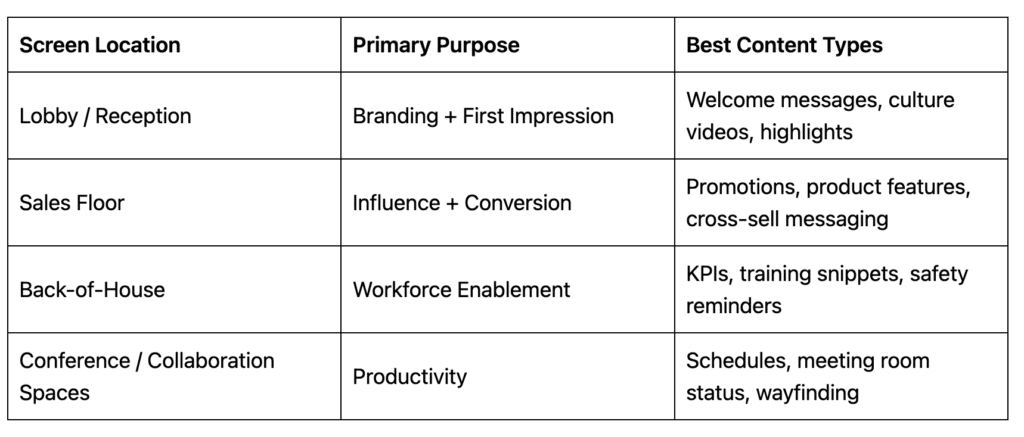
If you haven’t yet standardized screen placement, consider reviewing best practices for screen visibility, dwell zones, and sightlines before finalizing your content plan.
VP of Product Insight
“Great content isn’t just creative—it’s operational. If your teams can’t update it easily and consistently, the network will always underperform.”
Christian Armstrong, Vice President of Product Management
2. Mix High-Performing Content Types
A healthy enterprise content mix is diverse but intentional:
📺 Brand + Culture
High-quality brand storytelling sets tone, builds trust, and unifies messaging across locations.
💿 Product + Service Highlights
A must for any enterprise with retail or sales-floor environments.
📊 Data-Driven Content
Live dashboards, KPIs, or integrated feeds (POS, ERP, CRM) keep the network relevant and reduce manual updates.
📹 Short-Form Video
Motion captures attention. Videos under 10–12 seconds perform best in fast-moving environments.
🎙️ Contextual + Triggered Messaging
Weather, time of day, foot traffic, and proximity signals can dramatically improve engagement. This becomes even more powerful when paired with content triggers technology—a topic explored more deeply in a future guide.
3. Build a Smart Rotation Strategy
Consistency matters—but redundancy kills engagement.
Best Practices for Enterprise Rotations
- Update marquee content every 2–4 weeks
- Maintain a 60/40 ratio of evergreen to timely content
- Keep total loop length under 5 minutes for most public areas
- Prioritize movement—at least 40% of your loop should include motion or dynamic templates
- Match dwell time to loop strategy
- High dwell = longer loops
- Low dwell = short, repetitive hits
4. Adopt the Hybrid Governance Model
Enterprise networks fail most often due to unclear content ownership. The strongest governance model looks like this:
- Centralized teams define brand, templates, rules, and core messaging
- Local teams update specific content tailored to their site
This ensures brand safety without sacrificing local relevance.
5. Localize Without Losing Control
Localization is critical for large organizations—especially retail, healthcare, QSR, auto service, and multi-campus enterprises.
Effective Localization Strategies
- Use dynamic templates that lock down brand elements but allow local copy or pricing
- Create region-specific playlists while keeping a global baseline
- Support multiple languages where appropriate
Allow location managers to request or submit content through a controlled workflow.
“Content only works when it feels relevant. Templates let us maintain brand consistency while empowering each location to speak to its own audience.”
— Shannon Baker, Director of Production
6. Keep Content Fresh With an Organized Workflow
Enterprises often struggle with content aging out or staying on screen long after relevance fades.
To keep content fresh at scale:
- Build a 12-month editorial calendar with promotions, events, and campaigns
- Automate expiration dates inside your CMS
- Use live data integrations to reduce manual updates
- Review playlists quarterly
- Track performance and refine what earns attention
A clean workflow ensures your network never goes stale—and your teams aren’t overwhelmed.
7. Plan for Triggered and Automated Content (The Next Frontier)
While not required on day one, many enterprises benefit from context-aware content as their network matures.
Examples:
- Show rainy-day promotions when weather APIs trigger
- Switch messaging when foot traffic spikes
- Tailor employee alerts based on shift changes
- Use audience analytics to select the best content in real time
This is a deep topic in itself and is explored further in the upcoming guide on sensor-based content triggers and automation.
8. Connect the Content Strategy to Placement and Hardware Decisions
Content strategy does not exist in isolation.
You can strengthen this blog by linking to your other foundational posts:
✔ Link to placement best practices:
“If the content mix is the message, placement is the delivery system. See the guide on optimizing screen visibility and dwell zones.”
✔ Link to content triggers:
“For enterprises interested in context-driven automation, explore how content triggers elevate relevance without adding workload.”
Final Word
Achieving an effective digital signage content strategy in enterprise environments requires a blend of creativity, structure, and operational discipline. With the right content mix, a clear governance model, and an intelligent rotation strategy, your network becomes a scalable storytelling engine.
Recommended Resource
👉 Discover what the right digital signage system can do for your business! Book a demo today!
👉 Download our white paper, Is In-Store Retail Media Network Right for Me?, to see how signage fits into your in-store monetization strategy!