



Digital advertising venues are defined as physical and digital locations where brands deliver targeted messages to audiences in context, capturing attention at the moment it matters most. The role of digital advertising venues has grown sharply as marketing professionals recognize that online ads alone cannot reach every customer at every stage of the buying journey. Place-based media, the industry term for advertising delivered in physical spaces like retail stores, transit hubs, gyms, and healthcare waiting rooms, gives brands a channel that online platforms cannot replicate. Most successful brands now use between five and eight digital marketing channels to stay competitive. That range signals how critical it is to build a channel mix that includes both digital and physical touchpoints.
What are the key types of digital advertising venues?
Place-based media is the foundation of physical venue advertising. It targets people who are already present in a specific environment, waiting, shopping, or commuting, and therefore more attentive than online users suffering from ad fatigue. That captive audience dynamic is what separates venue advertising from every other channel.
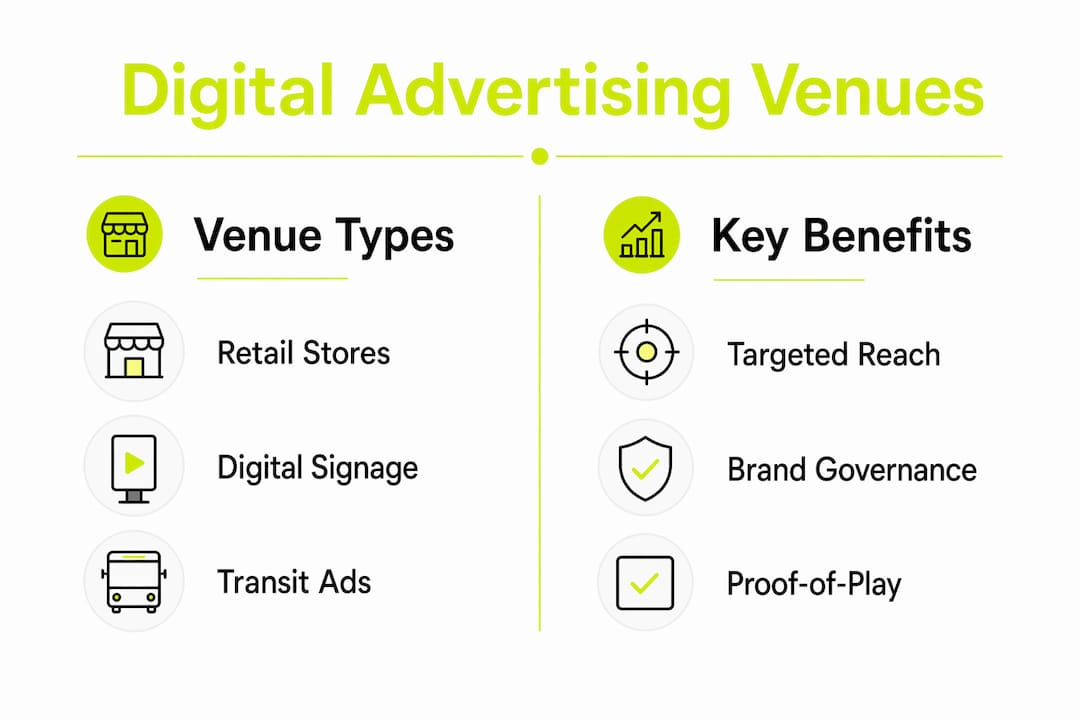
The main venue types each serve a distinct purpose:
- Retail digital signage: Screens inside stores display promotions at the point of purchase, where buying decisions happen in real time.
- Transit and commuter networks: Screens in subway stations, airports, and bus shelters reach high volumes of people during predictable daily routines.
- Healthcare waiting rooms: Patients sit for extended periods with limited distractions, producing some of the highest dwell times in any venue category.
- Gyms and fitness centers: Members visit regularly and spend 45–90 minutes per session, giving brands repeated exposure to a defined demographic.
- Hospitality and hotel lobbies: Guests are in a receptive, exploratory mindset, making them open to recommendations for dining, services, and local experiences.
Digital signage advertising networks act as monetization engines for venue owners by packaging screen time into standardized, sellable inventory. That standardization matters because it gives advertisers predictable delivery and verifiable reporting, two things that printed placements cannot offer.
| Venue type | Primary audience state | Key advertiser benefit |
|---|---|---|
| Retail stores | Active purchase intent | Drives immediate conversion |
| Transit hubs | Commuting, routine travel | High frequency, broad reach |
| Healthcare waiting rooms | Captive, low distraction | Long dwell time, high recall |
| Gyms and fitness centers | Engaged, health-focused | Repeated exposure, niche targeting |
| Hotel lobbies | Exploratory, receptive | Brand discovery, upsell opportunity |

Pro Tip: Design venue creative for a three-second glance. Unlike online ads, physical screens compete with the environment itself, not other ads. A single bold claim outperforms a cluttered layout every time.
How do digital advertising venues integrate with other digital marketing channels?
A venue campaign works best when it reinforces messages that customers already see online. Brands using five to eight channels report stronger customer connection than those relying on one or two. Physical venue ads serve as a bridge between the digital world and the real one, giving your omnichannel strategy a dimension that screens alone cannot provide.
Paid digital ads deliver immediate traffic while organic SEO and content marketing build momentum over 6–12 months. Venue advertising fills a different role entirely. It reaches customers who are not actively searching, placing your brand in front of them during moments of downtime or transition.
The most effective integrations combine venue ads with:
- Social media: A gym screen campaign can display a QR code linking to an Instagram contest, turning passive viewers into active followers. Integrating signage with social media amplifies both channels simultaneously.
- Email marketing: A retail screen promoting a loyalty program drives sign-ups that feed directly into your email list, creating a measurable downstream effect.
- SEO and content: High-quality organic content captures customers researching online, while venue ads reinforce the same brand message when those customers visit in person.
- Paid search: A customer who sees your ad on a transit screen and later searches your brand name on Google is far more likely to click your paid result. Venue exposure primes the conversion.
Social media drives top ROI for B2C marketers in 2026, with Instagram, Facebook, and YouTube used by roughly 70% of brands. Venue advertising does not compete with those channels. It amplifies them by creating real-world impressions that make online ads more familiar and trustworthy.
What unique advantages do digital advertising venues offer over online-only ads?
The clearest advantage is brand governance. In-venue screens present one brand message at a time, eliminating the clutter that defines most online ad environments. When your ad appears on a gym screen, it is not sandwiched between a competitor’s banner and an auto-play video. Your message owns the space.
Ad fatigue is a real cost for online campaigns. Audiences who see the same digital ad repeatedly begin to ignore it, and click-through rates drop accordingly. Venue advertising sidesteps this problem because the physical context changes the audience’s mental state. Consumers in waiting rooms or gyms are in states that encourage attention to place-based messages, making them more receptive than someone scrolling through a feed.
Measurement has also improved significantly. Digital signage networks provide proof-of-play reporting, verifying that your ad ran at the scheduled time and location. That level of accountability matches what programmatic online platforms offer, but without the fraud risk that plagues digital display advertising.
| Advantage | Online-only ads | Venue-based ads |
|---|---|---|
| Ad clutter | High, multiple ads compete | Low, often exclusive placement |
| Audience attention | Variable, easily scrolled past | High, captive environment |
| Brand governance | Limited, platform-controlled | Strong, venue-controlled |
| Measurement | Click and impression data | Proof-of-play, dwell time |
| Purchase intent alignment | Keyword or behavior-based | Physical context-based |
Standardizing digital signage inventory into sellable units transforms casual screen space into measurable media assets. That shift benefits both venue owners and advertisers. Owners generate revenue from existing infrastructure. Advertisers get consistent, auditable delivery.
Pro Tip: Keep venue ad copy to seven words or fewer for the headline. Physical environments demand faster comprehension than digital ones. Viewers are moving, waiting, or glancing, not reading.
How can you optimize campaigns using digital advertising venues?
Selecting the right venue type is the first decision. Match the venue to your audience’s mindset. A financial services brand belongs in a business hotel lobby, not a college gym. A sports nutrition brand fits a fitness center, not a hospital waiting room. Context alignment determines whether your message feels relevant or intrusive.
Programmatic buying for place-based networks allows real-time targeting by venue, time of day, and audience profile. A coffee brand can serve ads in commuter hubs during morning rush hour and switch to a different creative in the afternoon. That flexibility was not possible with printed placements and represents a genuine shift in how venue advertising operates.
A practical optimization checklist for venue campaigns:
- Define the audience context first. Know what your customer is doing in that venue before you write a single line of copy.
- Align creative with dwell time. Long-dwell venues like waiting rooms support more detailed messages. Short-dwell venues like transit screens need instant impact.
- Use proof-of-play data. Verify delivery and adjust scheduling based on which time slots produce the strongest downstream results.
- Coordinate with your online calendar. Run venue ads during the same windows as your paid search and social campaigns for maximum reinforcement.
- Refresh creative regularly. Venue audiences are often repeat visitors. Stale creative loses impact faster in physical spaces than online because the same people see it repeatedly.
- Measure downstream signals. Track whether venue markets show higher branded search volume, foot traffic, or in-store conversion rates compared to non-venue markets.
Understanding digital signage ROI requires connecting venue delivery data to business outcomes, not just impressions. The brands that get the most from venue advertising treat it as a performance channel, not a branding afterthought.
Pro Tip: Run a split test between two venue locations with different creative approaches. Physical venue testing is underused and often reveals audience preferences that online A/B tests miss entirely.
Key Takeaways
Digital advertising venues deliver measurable, high-attention brand exposure that online-only campaigns cannot replicate, making them a necessary component of any serious omnichannel strategy.
| Point | Details |
|---|---|
| Venue types vary by audience state | Match venue to customer mindset: retail for purchase intent, transit for frequency, waiting rooms for dwell time. |
| Brand governance is a core advantage | In-venue screens show one message at a time, eliminating ad clutter and improving recall. |
| Channel integration multiplies impact | Venue ads reinforce social, email, and paid search campaigns, making every other channel more effective. |
| Programmatic targeting is now available | Real-time venue targeting by location and time of day makes place-based media as flexible as digital display. |
| Proof-of-play enables accountability | Digital signage networks verify delivery, giving advertisers the same measurement standards as online platforms. |
Why physical venues deserve a permanent seat at the marketing table
I have spent years watching marketing budgets chase the newest online platform, and the pattern is always the same. Brands pile into a channel, costs rise, attention drops, and the search for the next thing begins. Physical venue advertising does not follow that cycle. The audience is there because they chose to be in that space, not because an algorithm served them content.
What surprises most marketing professionals when they first run a venue campaign is how well the data holds up. Proof-of-play reports are not estimates. They confirm that your ad ran, where it ran, and when. That certainty is rare in digital advertising, where impression fraud and viewability disputes are routine.
The emerging integration of AI-driven content scheduling in venue networks is the development I watch most closely. The ability to serve different creative based on time, weather, or local events, without manual intervention, makes venue advertising genuinely competitive with programmatic online buying. Brands that build venue campaigns into their planning cycles now, rather than treating them as a supplemental add-on, will hold a real advantage as that technology matures.
My honest recommendation: treat venue advertising as a first-party channel. You control the environment, the message, and the measurement. That combination is increasingly hard to find anywhere else in the long-term SEO and paid media world.
How Spectrio helps you build better digital advertising venues
Spectrio’s Intelligent Engagement Suite™ gives marketing professionals and business owners the tools to deploy, manage, and measure digital signage campaigns across multiple venue types from a single platform.
Spectrio’s digital signage solutions handle content scheduling, creative updates, and proof-of-play reporting, so your venue campaigns run with the same discipline as your online channels. The platform supports retail stores, healthcare facilities, hospitality environments, and more. Spectrio clients have used unique digital signage applications to increase dwell time, drive product awareness, and reinforce brand messaging at the point of purchase. If you are ready to see what venue advertising can do for your specific environment, Spectrio’s team is available to walk you through options and build a plan that fits your goals.
FAQ
What is the role of digital advertising venues in marketing?
Digital advertising venues are physical and digital locations where brands deliver targeted messages to captive audiences. They complement online channels by reaching customers in context, during moments of high attention and low distraction.
How do digital advertising venues differ from online ads?
Venue-based ads appear in physical spaces where one brand message typically owns the screen, eliminating ad clutter. Online ads compete with dozens of other placements on the same page or feed.
What types of businesses benefit most from place-based media?
Retail stores, healthcare providers, gyms, hotels, and transit operators all benefit from place-based media because their customers spend measurable time in a defined physical space.
How do you measure the effectiveness of venue advertising campaigns?
Digital signage networks provide proof-of-play reports that confirm when and where each ad ran. Marketers can also track downstream signals like branded search volume and in-store conversion rates in venue markets versus non-venue markets.
Can venue advertising work alongside SEO and social media?
Venue advertising reinforces online channels by creating real-world brand impressions that make paid search and social ads more familiar to customers. Brands using five to eight integrated channels consistently report stronger customer engagement than those using fewer.