

Customer loyalty program digital signage is defined as networked display technology that shows personalized reward status, point balances, and program offers to customers in real time at the point of experience. Done right, it turns a passive loyalty card into a live, visible relationship. Loyal customers carry up to 10x the lifetime value of a first-time buyer, which makes every screen in your location a retention asset. Spectrio’s Intelligent Engagement Suite™ connects content management, audience measurement, and CRM data into one platform, giving business owners a direct line between loyalty data and the displays customers actually see. This guide covers the tools, content design, common pitfalls, and ROI measurement methods you need to make that connection work in 2026.
What tools does customer loyalty program digital signage require?
Effective loyalty signage starts with the right infrastructure. You need commercial-grade displays, a reliable network connection, a content management system (CMS), and a live data feed from your loyalty platform or CRM. Without all four, the content on screen will be generic, static, and easy to ignore.
The CRM integration is the most critical piece. Real-time loyalty data on screens reduces customer confusion and builds staff efficiency by pre-informing customers of their rewards status before they reach the register. That means fewer questions at checkout, faster transactions, and a customer who already feels recognized.

Frictionless sign-up flows via phone number input on in-store screens remove the app-download barrier entirely. A customer who can join your program in 10 seconds on a screen near the entrance is far more likely to enroll than one who needs to download an app later. Pairing this with a CMS that supports dynamic content zones lets you show enrollment prompts to non-members and point balances to existing members on the same screen.
| Tool category | Purpose |
|---|---|
| Commercial displays | Show content at consistent brightness in high-traffic areas |
| Content management system | Schedule, update, and personalize content across all screens |
| CRM or loyalty platform API | Feed real-time member data to on-screen displays |
| Network infrastructure | Maintain stable connectivity for live data updates |
| Audience measurement software | Track dwell time and content engagement by location |
Pro Tip: Audit your loyalty data for accuracy before connecting it to any screen. Displaying a wrong point balance erodes trust faster than showing no balance at all.
How do you design and implement loyalty content for digital signage?
Content design is where most loyalty signage programs fail. Businesses connect the data feed, then push the same rotating slide to every screen. Personalized real-time content consistently outperforms generic signage in driving engagement, because customers respond to information that is specifically about them.
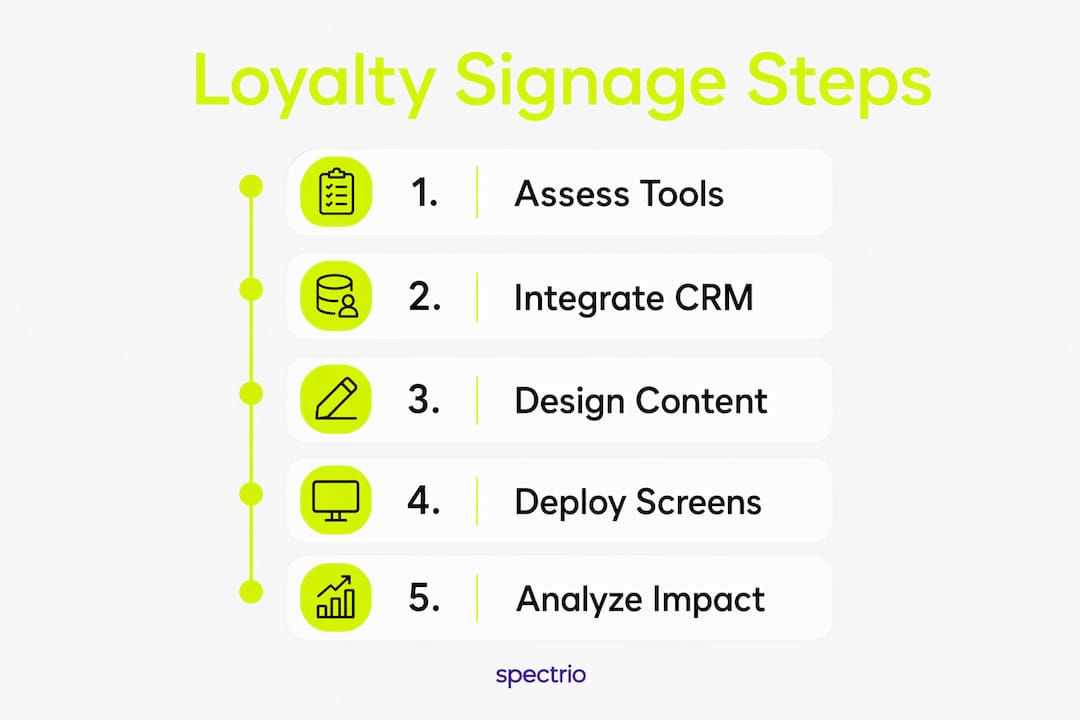
The implementation process follows a clear sequence:
- Segment your audience. Divide customers into tiers: new members, mid-tier members, and top-tier members. Each group needs different messaging. A new member needs encouragement and a clear path to the next reward. A top-tier member needs recognition and exclusive offers.
- Map content to location. Entrance displays work best for enrollment prompts and program awareness. Aisle displays suit product-specific offers tied to loyalty points. Checkout screens are ideal for point summaries and redemption nudges, since captive queue moments significantly improve loyalty registration rates.
- Build dynamic content zones. Use your CMS to create zones within each screen layout. One zone shows the member’s name and current point balance. Another shows the next reward threshold. A third rotates promotional content. This structure keeps the screen informative without feeling cluttered.
- Blend loyalty with other content. Loyalty signage can include product cross-sells, local events, and customer feedback prompts alongside reward updates. This variety keeps the content fresh and prevents customers from tuning it out.
- Test before full deployment. Run your content on one or two screens for two weeks. Watch for data sync errors, layout issues, and customer reactions before rolling out to every display.
- Schedule content by time of day. Morning traffic responds differently than evening traffic. A coffee shop might show breakfast bundle offers with loyalty points in the morning and happy hour rewards in the afternoon.
Pro Tip: Use progress bars to show how close a customer is to their next reward. A visual “8 points to your free item” outperforms a text-only message because it triggers the same completion instinct as a loading bar.
Thinking about customer retention strategies beyond signage? Loyalty signage works best as part of a broader retention system that includes email, staff training, and in-store experience design.
What are common challenges with loyalty digital signage?
The most damaging mistake is data latency. When a customer sees a point balance on screen that does not match what the cashier reads at checkout, trust breaks immediately. This problem comes from poor API configuration or infrequent data refresh cycles. Set your data sync to update at least every 60 seconds, and build in error states that show a neutral message when the feed fails rather than stale data.
Common challenges and their solutions:
- Generic messaging: Screens show the same content to every customer. Fix this by connecting your CMS to your loyalty platform’s member ID system and using conditional content rules.
- Screen overload: Too many messages compete for attention. Limit each screen to two or three content zones and rotate no more than four messages per cycle.
- Display sync failures: Multiple screens show different content versions. Use a cloud-based CMS with centralized publishing to push updates to all screens simultaneously.
- Low enrollment rates: Customers walk past sign-up prompts. Place enrollment screens at eye level near high-dwell areas like waiting zones and checkout lines.
- Staff unfamiliarity: Employees cannot answer customer questions about what the screen shows. Brief your team on the content schedule and what each screen is designed to communicate.
- Content staleness: Promotions expire but screens still show old offers. Set automatic expiration dates in your CMS for every time-sensitive piece of content.
Measuring impact before and after addressing each challenge is the only way to know which fix actually moved the needle. Gut instinct does not replace data when you are managing a loyalty program at scale. You can learn more about enhancing customer service through display strategy on the Spectrio resource library.
How do you measure and maximize ROI from loyalty digital signage?
ROI measurement for loyalty signage requires a baseline. Define your success metrics before installation and run a 60-day pre-installation measurement period. Without that baseline, you cannot attribute any change in behavior to the signage itself.
The four metrics that matter most are footfall, average basket size, repeat-visit rate, and dwell time. Footfall tells you whether the signage is drawing people in. Basket size tells you whether loyalty offers are changing purchase behavior. Repeat-visit rate is the clearest signal of retention impact. Dwell time tells you whether customers are actually reading the content.
| Measurement approach | What it tracks | Best used for |
|---|---|---|
| Pre/post footfall analysis | Change in store traffic after signage installation | Awareness and draw |
| Basket size comparison | Average transaction value for loyalty members vs. non-members | Offer effectiveness |
| Repeat-visit rate tracking | Frequency of return visits among loyalty members | Retention impact |
| QR code redemption tracking | Clicks and conversions from screen-displayed QR codes | Direct engagement |
| Dwell time measurement | Time customers spend near specific screens | Content relevance |
QR codes on checkout screens generate 3–7% conversion rates, compared to under 1% for email surveys. That gap makes on-screen QR codes one of the most measurable engagement tools available. Use them to track loyalty sign-ups, offer redemptions, and feedback submissions separately so you can attribute each result to a specific screen and content type.
For a deeper look at maximizing signage ROI, Spectrio’s resource library covers measurement frameworks built specifically for multi-location businesses.
Pro Tip: Use closed-loop measurement to connect a specific screen impression to a loyalty redemption. Tag each offer with a unique code, then match redemption records to the screen that displayed it. This turns your signage from a cost center into a documented revenue driver.
Relationship marketing principles apply directly here. The goal is not just a single transaction but a pattern of behavior that compounds over time.
Key Takeaways
Customer loyalty program digital signage drives measurable retention gains only when real-time CRM data, personalized content design, and 60-day baseline measurement work together from day one.
| Point | Details |
|---|---|
| CRM integration is non-negotiable | Connect your loyalty platform’s live data feed to every screen before launch. |
| Personalization beats generic content | Show member-specific point balances and progress bars to reduce banner blindness. |
| Placement determines enrollment rates | Checkout and high-dwell areas produce the highest loyalty sign-up conversions. |
| Baseline data enables real ROI proof | Measure footfall, basket size, and repeat visits for 60 days before installation. |
| QR codes outperform email for engagement | On-screen QR codes convert at 3–7%, versus under 1% for email surveys. |
Loyalty signage works when you treat it as CRM, not decoration
After working with businesses across retail, food service, and hospitality, the pattern is consistent. The programs that fail treat digital signage as a broadcast channel. They push the same slide deck to every screen and wonder why enrollment numbers do not move. The programs that succeed treat every screen as an extension of the CRM. They ask: what does this specific customer need to see right now, at this location, at this stage of their loyalty journey?
Loyalty programs connected to in-store signage eliminate their abstract nature by providing real-time visibility. That is the shift that matters. A loyalty card in a wallet is invisible. A screen that says “You have 240 points. Your next reward is 60 points away” is a conversation. It does not require a staff member to initiate it, and it does not require the customer to open an app.
The other thing I have seen consistently: businesses underestimate how much signage reduces staff friction. When customers already know their point balance from the screen near the entrance, they arrive at the register informed. That shortens the transaction and removes a common source of checkout frustration.
Customer expectations in 2026 are shaped by personalized digital experiences everywhere else in their lives. A loyalty program that feels generic feels broken. Signage that reflects who the customer is and what they have earned makes the program feel alive. That feeling is what earns the next visit.
How Spectrio supports loyalty program digital signage
Spectrio’s platform connects content management, real-time data integration, and audience measurement in one place, which is exactly what loyalty signage requires to perform at scale.
Spectrio’s Intelligent Engagement Suite™ gives you the tools to display personalized loyalty content across every screen in your location, update offers in real time, and measure what is actually working. Whether you manage one location or hundreds, the platform handles content scheduling, CRM data sync, and performance tracking without requiring a dedicated IT team. Explore unique ways to use digital signage for loyalty programs, or review the signage software comparison guide to find the right fit for your business.
FAQ
What is customer loyalty program digital signage?
Customer loyalty program digital signage is networked display technology that shows personalized reward data, point balances, and program offers to customers in real time at the point of experience. It connects CRM or loyalty platform data directly to in-store screens.
How does digital signage increase loyalty program enrollment?
Signage near registers captures customers during checkout waits, and on-screen sign-up prompts via phone number input remove the app-download barrier. This frictionless approach consistently raises participation rates compared to passive print materials.
What metrics should I track for loyalty signage ROI?
Track footfall, average basket size, repeat-visit rate, and dwell time over a 60-day baseline period before and after installation. QR code redemption rates on screen-displayed offers provide the most direct attribution data.
How often should loyalty signage content be updated?
Update time-sensitive offers as soon as they change, and refresh evergreen content at least monthly to prevent customers from tuning it out. Set automatic expiration dates in your CMS for every promotion to avoid showing stale offers.
Can digital signage replace staff for loyalty program communication?
Digital signage handles awareness, enrollment prompts, and point balance display without staff involvement. It does not replace staff for complex questions or redemption disputes, but it significantly reduces the volume of routine loyalty inquiries at the register.